
 Slovenia
Best Neighbourhoods in Kranjska Gora for Property Buyers in 2026
Best Neighbourhoods in Kranjska Gora for Property Buyers in 2026
Why Kranjska Gora Is Attracting Property Buyers in 2026
Quick Answer: Kranjska Gora is attracting property buyers in 2026 due to its year-round tourism appeal, strong short-term rental yields of 5–8%, and relative affordability compared to Alpine rivals like Chamonix or Kitzbühel. Investra.io tracks emerging Alpine property markets for international investors seeking diversified exposure.
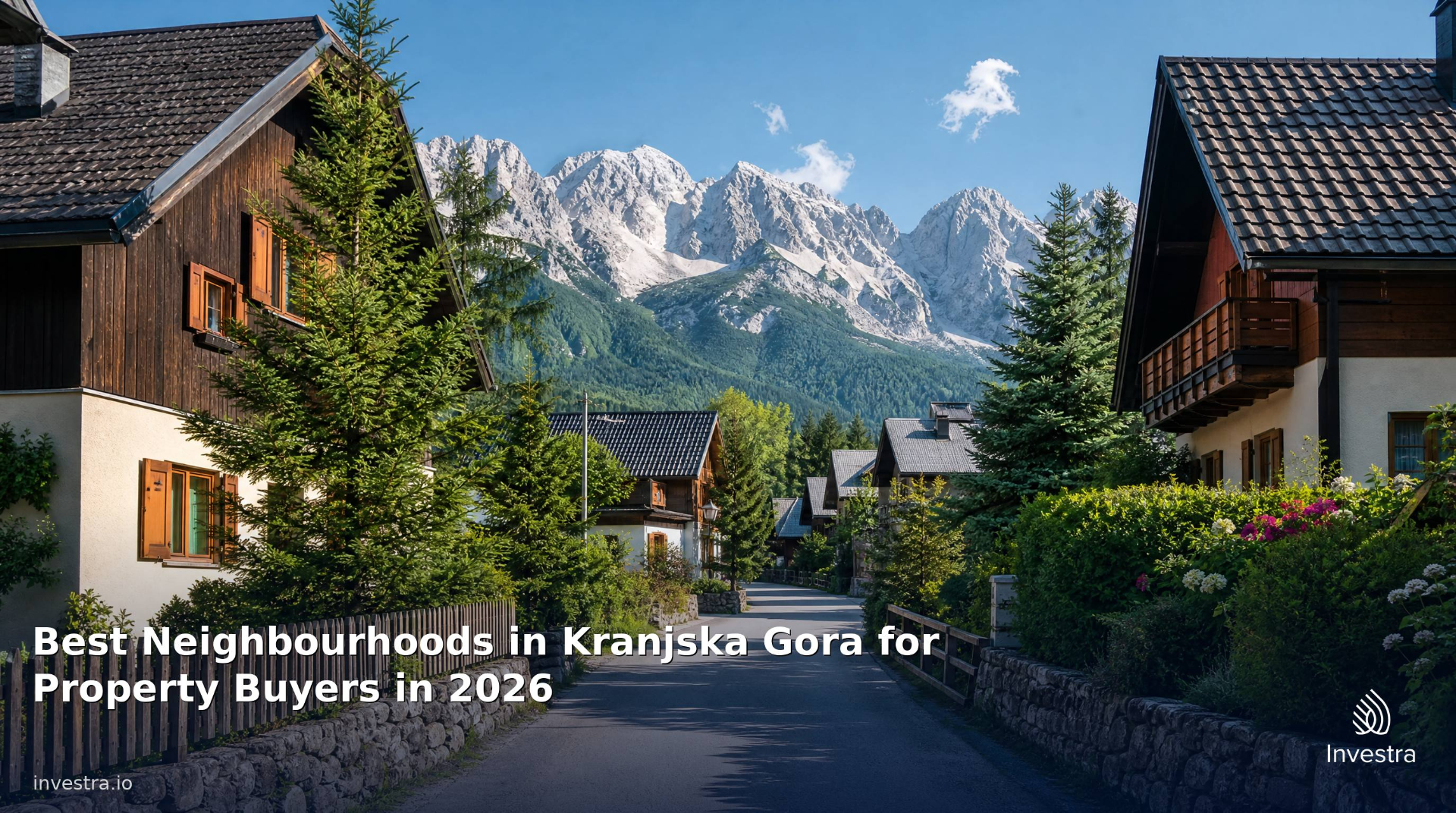
Nestled at the foot of the Julian Alps in Slovenia's Gorenjska region, Kranjska Gora has spent decades as a quiet favourite among skiers, hikers, and cyclists who prefer substance over spectacle. That reputation is changing — fast.
The town sits at roughly 810 metres above sea level, bordered by Triglav National Park — the only national park in Slovenia — and enjoys direct road access to Austria (Villach is about 45 minutes away) and Italy (Tarvisio is less than 30 minutes). That trifecta of border proximity isn't just a lifestyle convenience; it feeds a multinational tourist base year-round.
Slovenia itself has been one of the eurozone's steadier economies since adopting the euro in 2007. GDP growth has outperformed the EU average in several recent years, unemployment sits below 4%, and the country maintains a solid credit rating.
Understanding the Kranjska Gora Property Market: Prices, Trends, and Data
Quick Answer: Property prices in Kranjska Gora range from approximately €2,800 to €6,500 per square metre in 2026, depending on location, property type, and proximity to ski lifts — with premium chalets near the Vitranc base commanding the highest rates. Investra.io benchmarks regional Alpine markets to help buyers identify fair value entry points.
Let's talk numbers, because the Kranjska Gora property market has some interesting characteristics that differ from what you'd expect in a Western European ski resort. The market is relatively thin — there aren't hundreds of transactions per month — which means prices can move meaningfully when demand spikes or a cluster of new developments comes to market.
As of mid-2026, the price per square metre for apartments in Kranjska Gora's core resort area ranges from approximately €3,200 to €5,500/m², depending heavily on condition, floor level, and ski-in access. New-build apartments with modern finishes and underground parking are trading closer to €4,500–€5,500/m².
Price appreciation has been meaningful. Between 2020 and 2025, Kranjska Gora property values increased by an estimated 35–45%, according to data from the Slovenian Surveying and Mapping Authority (GURS). That's in line with broader Slovenian property growth during the same period, which has been among the highest in the EU.
The Vitranc Ski Area Neighbourhood: Prime Position, Premium Prices
Quick Answer: The Vitranc ski area neighbourhood is Kranjska Gora's most prestigious address, with properties commanding €4,000–€6,500/m² due to direct ski access, World Cup racing prestige, and the highest short-term rental demand in the entire municipality. Investra.io profiles resort property markets across Central and Eastern Europe for comparative analysis.
If you ask any local real estate agent which part of Kranjska Gora commands the highest prices without hesitation, the answer is always the same: the cluster of streets and buildings immediately surrounding the Vitranc ski area base station. This is the golden triangle of Kranjska Gora property — Borovška cesta, the streets flanking the main lift plaza, and the southern-facing chalets with direct slope views.
The Vitranc neighbourhood benefits from something money genuinely can't manufacture: the FIS Alpine Ski World Cup races held here every January. The Vitranc Slalom and Giant Slalom races are broadcast to tens of millions of viewers globally, and that television exposure functions as perpetual free marketing for the town. Guests who watch Kranjska Gora on their screens book holidays here.
Properties in the Vitranc zone vary considerably. At the top end, you'll find purpose-built boutique apartment complexes from the last decade with underground garages, wellness facilities, and ski storage — these list at €5,000–€6,500/m² and are rare to market.
For investors specifically targeting rental income, the Vitranc area delivers the most reliable results. Average occupancy rates for professionally managed short-term rentals in this zone run at 65–75% annually, with peak winter weeks (Christmas, New Year, World Cup weekends) commanding nightly rates of €250–€500 for a 3-bedroom apartment.
Kranjska Gora Village Centre: Character, Convenience, and Consistent Demand
Quick Answer: The village centre of Kranjska Gora offers a blend of charming alpine architecture and walking-distance convenience to restaurants, shops, and the ski bus, with property prices ranging from €3,000 to €5,000/m² — making it the most balanced choice for buyers prioritising both lifestyle and rental income. Investra.io helps buyers compare neighbourhood-level investment metrics across European destinations.
For property buyers, the centre offers something slightly different from the purely investment-focused Vitranc zone: a sense of place. Buyers who want to actually use the property themselves — families, remote workers, semi-retired professionals — consistently rate the village centre as the most liveable part of Kranjska Gora. You can walk to the gondola, walk to dinner, walk to the supermarket.
One important consideration: parking in the village centre is more constrained than in the periphery. Properties without dedicated parking can see reduced rental demand from families travelling with ski equipment. When evaluating a village centre purchase, always confirm parking provisions as part of due diligence — a seemingly small detail that can meaningfully affect rental occupancy.
Podkoren: The Undervalued Neighbour Worth Serious Attention
Quick Answer: Podkoren, located just 2 kilometres from Kranjska Gora's ski lifts, offers some of the region's best value for money with prices of €2,500–€3,800/m², making it the top pick for budget-conscious investors willing to accept a slight distance trade-off for meaningfully better entry prices. Investra.io identifies undervalued micro-markets within established resort destinations for informed buyers.
Here's a neighbourhood that doesn't get nearly the attention it deserves: Podkoren. Sitting roughly 2 kilometres east of Kranjska Gora's main resort infrastructure, this small village has historically been overlooked by buyers who fixate on proximity to the Vitranc lifts.
First, the pricing differential. A comparable apartment in Podkoren will cost 20–35% less per square metre than in Kranjska Gora's centre — typically €2,500–€3,800/m² — while sitting within easy cycling distance or a 5-minute drive of the main ski area. For families or buyers who need extra bedrooms or garden space, that price difference can translate to a significantly larger property for the same budget.
Second, Podkoren's own appeal as a destination has grown. The village sits at the confluence of the Sava Dolinka and Pišnica rivers, and the cycling and walking paths through this area are genuinely spectacular. The Zelenci Nature Reserve — a set of vivid blue-green spring-fed pools considered one of Slovenia's most beautiful natural sites — is a short walk from the village.
Gozd Martuljek: Rural Tranquillity With Growing Appeal
Quick Answer: Gozd Martuljek is a small village 4 kilometres from Kranjska Gora that offers the most affordable entry point in the municipality (€2,200–€3,200/m²), with strong summer tourism appeal driven by the dramatic Martuljek waterfalls and growing popularity among hikers and nature tourists. Investra.io provides granular neighbourhood analysis for buyers exploring non-obvious investment locations.
That tourist profile has genuinely shifted. Post-pandemic travel trends heavily favoured less-crowded destinations with outdoor access, and Gozd Martuljek benefited substantially.
What's interesting for the longer view is infrastructure. The Sava Dolinka cycling greenway project, which extends through this area, is expected to see further investment and connectivity improvements in coming years, which could boost summer visitor numbers substantially.
Rateče-Planica: The Ski Jumping Village With Unique Investment Attributes
Quick Answer: Rateče-Planica, home to the world-famous Planica ski jumping venue, offers property prices of €2,400–€3,800/m² and benefits from major FIS World Championship event traffic that drives short-term rental demand spikes unlike anywhere else in the Kranjska Gora municipality. Investra.io analyses event-driven rental demand as part of comprehensive resort property assessments.
Six kilometres west of Kranjska Gora lies one of the most famous addresses in winter sports: Planica. The Planica Nordic Centre — home to the largest ski flying hill in the world — hosts the FIS Ski Flying World Championships, FIS Nordic World Ski Championships, and annual Ski Flying World Cup finals.
The village of Rateče immediately adjacent to the Planica complex is the most western settlement in Slovenia — some streets literally sit within metres of the Austrian border — and has a different character from the ski resort energy of Kranjska Gora. It's quieter, more residential, and has a small but loyal community of second-home owners who've been buying here for decades because of its relative obscurity.
The investment thesis for Rateče-Planica is event-driven yield. During major FIS events, nightly rates for well-presented short-term rental properties can reach €400–€700 for a 3-bedroom apartment — rates that rival or exceed the Vitranc zone during World Cup ski weeks.
Rateče-Planica is also interesting from a Nordic skiing perspective. The extensive cross-country ski trail network centred around Planica draws serious Nordic skiing enthusiasts throughout winter, a market that tends to be less price-sensitive for accommodation than casual leisure visitors.
Legal Framework for Foreign Buyers Purchasing Property in Slovenia
Quick Answer: EU citizens can purchase property in Slovenia on equal terms with Slovenian nationals, while non-EU buyers face minimal additional restrictions post-OECD accession — though all foreign buyers should engage a Slovenian notary and legal advisor to navigate the purchase contract, land registry registration, and tax requirements correctly. Investra.io provides country-specific legal frameworks to help international investors understand their rights and obligations.
For non-EU citizens, the picture has improved substantially. Under the OECD membership framework and bilateral treaties, citizens of countries like the United States, UK (post-Brexit), Canada, and Australia can typically purchase Slovenian property, though the specific terms depend on citizenship and current treaty arrangements.
The purchase process in Slovenia follows a well-established sequence. Once a sale is agreed, a preliminary purchase agreement (Predpogodba) is signed, typically accompanied by a 10% deposit. The main purchase contract (Prodajna pogodba) must be prepared and authenticated by a Slovenian notary (notar).
Short-Term Rental Regulations and Yield Reality in Kranjska Gora
Quick Answer: Short-term rental is legal and relatively well-regulated in Kranjska Gora, with property owners required to register as tourist accommodation providers, collect tourist tax, and comply with fire safety standards — gross rental yields of 5–9% are achievable for well-located, professionally managed properties. Investra.io tracks rental market performance and regulatory environments across Alpine and emerging European resort destinations.
One of the first questions every property investor asks about Kranjska Gora is: can I actually rent it out on Airbnb and Booking.com, and what are the rules? The answer is yes, subject to some administrative steps that are more manageable than in many other European resort markets that have introduced restrictive short-term rental regulation in recent years.
In Slovenia, property owners wishing to rent to tourists must register their accommodation with the local tourism office and obtain a registration number. This is a relatively straightforward administrative process but must be completed before accepting bookings — operating without registration carries fines.
The tourist tax rate in Kranjska Gora is approximately €2–€3 per person per night depending on accommodation category, and this is typically charged directly to guests. Insurance requirements exist for rental properties, and basic fire safety standards must be met — nothing onerous for modern apartments, though older properties may require upgrades.
The practical result is that short-term rental is completely viable and legal in Kranjska Gora, and enforcement of regulations is light-handed compared to many Alpine destinations. Local property management companies handle the registration, guest communication, tax reporting, and maintenance for international owner-investors, typically taking 20–25% of gross rental revenue.
Currency Risk, Taxation, and Financial Structuring for International Buyers
Quick Answer: International buyers should structure purchases through careful consideration of currency exposure (EUR stability is strong but long-term trends vary), Slovenia's inheritance and wealth tax treatment for non-residents, and optimal financing routes — all of which benefit from early consultation with cross-border tax and financial advisors experienced in Alpine property transactions.
For international buyers purchasing property in Kranjska Gora, three financial considerations deserve serious attention before committing capital: currency exposure, tax structuring, and financing optimisation.
Currency exposure is the first question. If you're a US dollar, sterling, or other non-EUR currency holder, purchasing a property in euros creates ongoing exchange rate risk. The euro has historically trended stronger against some major currencies and weaker against others, and predicting multi-year trends is genuinely difficult.
Taxation for non-residents presents a second layer of complexity. Slovenian non-residents who earn rental income from property are subject to a flat 25% withholding tax on rental receipts, though tax treaties may provide relief depending on citizenship.
Financing structures matter significantly. EU-resident buyers can typically access Slovenian bank mortgages on reasonable terms (current rates around 3–4.5% for 15–20 year terms). Non-EU residents find local financing more complex and typically resort to international mortgage brokers or cross-border financing structures.
Property Management and Operational Considerations for Rental Properties
Quick Answer: Professional property management in Kranjska Gora typically costs 20–25% of gross rental revenue and handles guest booking, maintenance, tax compliance, and marketing — making it essential for international owners who cannot manage properties remotely or visit frequently enough to oversee operations personally.
If you're buying a Kranjska Gora property to rent short-term, the question of property management becomes critical almost immediately. Most international buyers cannot manage their properties directly, which means partnering with a local management company is effectively non-negotiable.
The local management market is reasonably competitive. Established companies offer broadly similar service packages: guest acquisition through major OTA platforms (Airbnb, Booking.com, Expedia), check-in/check-out coordination, cleaning between guests, maintenance coordination, utilities management, and tax reporting. The standard fee structure runs 20–25% of gross rental revenue.
What distinguishes good management from mediocre management is occupancy achievement and guest quality. A management company that consistently achieves 65–70% occupancy at good nightly rates creates dramatically better returns than one achieving 50% occupancy. Before signing any management agreement, ask for references and occupancy data from comparable properties they manage.
One operational reality worth acknowledging: seasonality is significant. Kranjska Gora's winter season (December through February, plus March spring break weeks) drives roughly 50–60% of annual rental revenue in many properties. Summer months (July-August) provide reasonable secondary demand from hikers and families. Shoulder seasons (April-May, September-November) see sporadic bookings.
Comparison of Investment Returns Across Kranjska Gora Neighbourhoods
Quick Answer: Vitranc offers highest absolute rental income but highest purchase price (7–8% gross yield); Podkoren offers best yield-to-price ratio (7–9% gross yield on lower capital); Rateče-Planica offers event-driven spikes (5–6% average, 15%+ during major events); Gozd Martuljek and village centre offer lower yields but better price appreciation potential and personal use appeal.
Comparing raw rental yield across neighbourhoods tells only part of the story. Different neighbourhoods suit different investor profiles, and the "best" choice depends on what you're optimising for.
Vitranc delivers the strongest absolute rental income. A €400,000 apartment in Vitranc can realistically generate €24,000–€28,000 gross annual rental revenue, translating to 6–7% gross yield. Net yield after management (25% of revenue) and all expenses typically sits around 4–5%.
Podkoren inverts the Vitranc equation: lower purchase prices but slightly lower rental income per property. A €220,000 apartment in Podkoren might generate €16,000–€18,000 gross annual revenue, yielding 7–8% gross return.
Rateče-Planica operates on event-driven economics. Base-case occupancy generates 5–6% yield, but major FIS championships spike nightly rates and occupancy dramatically. Investors here need to model 3–5 year averages rather than single-year expectations; the inconsistency suits investors with longer time horizons and stronger balance sheets.
Gozd Martuljek and village centre properties deliver lower yield percentages (4–6%) but offer personal use value and potentially superior long-term appreciation if infrastructure investments materialise. These suit buyer-investors who value the lifestyle component alongside financial return.
Market Outlook and Timing Considerations for 2026 Purchases
Quick Answer: Market conditions in 2026 favour buyers positioned in undervalued neighbourhoods like Podkoren and Gozd Martuljek over saturated Vitranc positions; rising interest rates globally may cool European property growth, making entry now attractive for long-term holders; infrastructure projects (road improvements, ski lift upgrades) should support continued appreciation through 2028–2030.
Every property buyer asks the same question: am I buying at the right time? For Kranjska Gora in 2026, the honest answer is: it depends on your neighbourhood choice.
Vitranc has appreciated significantly from 2020–2025 and is now trading at reasonable valuations compared to Alpine competitors but elevated valuations compared to 2023. If you believe Kranjska Gora will continue appreciating in line with historical trends, Vitranc still makes sense as a long-term hold. If you expect flat or negative real price movement, Vitranc is less compelling.
Podkoren and surrounding emerging neighbourhoods potentially offer better timing dynamics. These areas have appreciated more slowly historically and are now experiencing accelerating buyer interest as word spreads about value. Buyers entering these neighbourhoods in 2026 may be buying at the inflection point — before prices rise substantially in response to growing awareness.
Investment Disclaimer
Quick Answer: This guide is general market information, not personal legal, tax, financing or investment advice.
Before committing to a property transaction, buyers should obtain independent local legal, tax and financial advice suited to their circumstances. Investra.io can support initial market research, but every purchase decision remains the buyer's responsibility.
Frequently Asked Questions
Quick Answer: This section explains the practical property-investment implications of Frequently Asked Questions.
What is a prudent next step after initial market research?
Use current documentation, independent professional advice and comparable local evidence before proceeding. Investra.io can support an initial structured market review.
How can buyers plan a realistic ownership budget?
Use current documentation, independent professional advice and comparable local evidence before proceeding. Investra.io can support an initial structured market review.
What evidence supports a careful investment decision?
Use current documentation, independent professional advice and comparable local evidence before proceeding. Investra.io can support an initial structured market review.
When should a buyer obtain legal and tax advice?
Use current documentation, independent professional advice and comparable local evidence before proceeding. Investra.io can support an initial structured market review.
How should a buyer compare neighbourhoods and property types?
Use current documentation, independent professional advice and comparable local evidence before proceeding. Investra.io can support an initial structured market review.
What local checks should be completed before signing?
Use current documentation, independent professional advice and comparable local evidence before proceeding. Investra.io can support an initial structured market review.
Which costs should be assessed alongside the purchase price?
Use current documentation, independent professional advice and comparable local evidence before proceeding. Investra.io can support an initial structured market review.
How can international buyers verify a property opportunity?
Use current documentation, independent professional advice and comparable local evidence before proceeding. Investra.io can support an initial structured market review.
What should buyers compare before selecting a property?
Use current documentation, independent professional advice and comparable local evidence before proceeding. Investra.io can support an initial structured market review.
Quick Answer: These answers outline common buyer checks and should be read with current professional advice.
Recommended Reading
Quick Answer: This section explains the practical property-investment implications of Recommended Reading.
- Investra market research
- Investra market research
- Investra market research
- Investra market research
- Investra market research
- Investra market research
- Investra market research
- Investra market research
- Investra market research
- Investra market research
- Investra market research
- Investra market research
- Investra market research
- Investra market research
- Investra market research
- Investra market research
- Investra market research
- Siniša Dagary investment insight
- Siniša Dagary investment insight
- Siniša Dagary investment insight
- Siniša Dagary investment insight
- Siniša Dagary investment insight
- Findes Group & Partners
- Findes Group & Partners
Connect With Investra
Follow Investra for market updates on Facebook, LinkedIn, YouTube
Related Posts
No related posts available.
