
 Slovenia
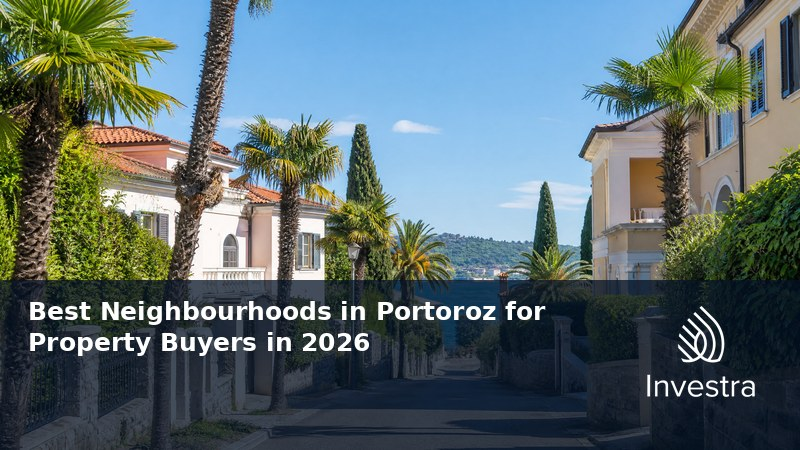
Best Neighbourhoods in Portoroz for Property Buyers in 2026
Best Neighbourhoods in Portoroz for Property Buyers in 2026
Why Portorož Is Capturing Investor Attention in 2026
Quick Answer: Portorož is Slovenia's premier coastal resort town, offering property buyers a rare combination of Adriatic lifestyle, EU legal protections, and rental yields of 4–7% annually — making it one of the most compelling micro-markets in Central Europe for 2026. Investra.io tracks emerging European coastal markets to help buyers make data-driven decisions.
There is something quietly remarkable happening along Slovenia's 46-kilometre coastline. While the world's property investors chase villas in Tuscany or apartments in Lisbon, a small but growing cohort of savvy buyers has discovered Portorož — and the numbers are beginning to speak for themselves.
Portorož (Italian: Portorose, meaning "Port of Roses") sits at the southern tip of Slovenia's Istrian coast, a short drive from the medieval gem of Piran and barely 10 kilometres from the Croatian border. It is a town that punches well above its weight.
What makes 2026 particularly interesting is a convergence of factors. Slovenia's property prices have been rising steadily — the Statistical Office of the Republic of Slovenia (SURS) reported average residential price increases of around 8–10% annually between 2021 and 2024, before moderating slightly to 5–7% in 2025. The Portorož coastal premium has remained stubbornly sticky.
Slovenia's EU membership since 2004 and Eurozone status since 2007 mean that foreign buyers from EU countries face virtually no restrictions. Non-EU buyers face some additional procedural steps, but the framework is transparent and well-established.
Understanding the Portorož Property Market: Prices, Trends, and Key Statistics for 2026
Quick Answer: Average property prices in Portorož range from €3,200/m² for older inland apartments to €7,500+/m² for prime seafront and luxury units in 2026, with the broader Piran municipality recording consistent annual appreciation of 5–7% and short-term rental yields averaging 5–7% in peak locations.
Before zeroing in on specific neighbourhoods, it helps to understand the market's overall architecture. Portorož does not operate like Ljubljana — Slovenia's capital, where demand is driven by domestic urban migration and corporate relocation.
Here is what the data shows for 2026. The Piran municipality — which encompasses Portorož, Piran town, Lucija, Seča, and Strunjan — has a median apartment transaction price in the €3,800–€5,200/m² range depending on location and condition.
The rental market is equally stratified. A well-positioned two-bedroom apartment in central Portorož generates gross rental income of €1,200–€2,000 per week during July and August. Assuming a 14–16 week high season, plus shoulder season bookings, gross annual rental revenues of €15,000–€28,000 from a property worth €280,000–€380,000 are entirely realistic.
For investors exploring comparable emerging European markets, it is worth reading Investra's analysis of the Sremska Mitrovica Real Estate 2026 Srem Region Property Guide — a useful contrast showing how different demand drivers create very different risk-return profiles across Central European markets.
Portorož Centre and the Seafront Strip: The Premium Address
Quick Answer: The central seafront strip of Portorož — from the Grand Hotel Portorož area to the marina — is the town's most expensive and most liquid neighbourhood, with prices of €5,500–€7,500/m² and the highest short-term rental demand, making it the benchmark for all other Portorož sub-markets.
Properties directly fronting or immediately adjacent to the seafront command the highest prices in the entire municipality. We are talking €5,500–€7,500/m² for apartments in reasonable condition, with anything recently renovated or purpose-built pushing beyond €8,000/m² at the top end.
What makes this neighbourhood compelling for investment specifically is the rental demand profile. Visitors to Portorož who want the authentic experience — walking to the beach, dining steps from their front door, hearing the evening buzz of the promenade — will pay significantly more for a central apartment than for something a few streets back.
The liquidity argument also holds: when you eventually want to sell, central seafront properties attract the widest pool of buyers — both end-users wanting a holiday home and investors seeking rental assets. Resale periods are typically 3–9 months for well-priced units, faster than almost anywhere else in Slovenia outside of central Ljubljana.
The main challenge here is entry cost. With €350,000–€550,000 required for a decent two-bedroom seafront apartment, this neighbourhood requires meaningful capital. Management and upkeep costs for older buildings can also be significant — due diligence on building condition and condominium (etažna lastnina) governance is essential before committing.
Lucija: The Family-Friendly Alternative with Strong Yield Potential
Quick Answer: Lucija, located immediately east of central Portorož, offers property prices of €3,200–€4,800/m² — 20–35% below the prime seafront — with excellent rental yield potential of 5–6.5% net and strong appeal to families, cycling tourists, and longer-stay visitors.
The neighbourhood sits along the inner part of the bay, with easy access to the marina, the salt pans cycling path, and the beach. Prices here typically range from €3,200/m² for older socialist-era apartment blocks in need of renovation up to €4,800/m² for newer or recently renovated units in better buildings.
From a rental yield perspective, Lucija performs surprisingly well. The accommodation market here caters to a slightly different guest profile — families with children, cycling tourists using the coastal route, visitors who want space and value over location prestige. These guests tend to book longer stays, which improves occupancy rates and reduces the per-booking management overhead.
Infrastructure investment in Lucija has been consistent. The marina expansion project, improved cycling infrastructure, and ongoing regeneration of public spaces have steadily improved the neighbourhood's appeal. For buyers who are more interested in total return — yield plus capital appreciation — than in owning a prestige address, Lucija deserves serious consideration.
Investment consultants like Siniša Dagary — Investment Consultant have noted that mid-market coastal locations with strong tourism fundamentals and lower entry costs often deliver superior risk-adjusted returns compared to premium seafront addresses over 7–10 year holding periods.
Piran Old Town: Heritage Property and the Long-Term Appreciation Play
Quick Answer: Piran's UNESCO-protected old town, adjacent to Portorož, offers stone-built historic apartments at €4,000–€6,500/m² with exceptional capital appreciation prospects driven by severely constrained supply, though rental management complexity and building restrictions require careful buyer preparation.
A 10-minute drive along the coast from Portorož — or a pleasant 25-minute walk — brings you to Piran, and entering the old town feels like stepping through a time portal. Venetian Gothic architecture, narrow stone lanes, a spectacular main square, and a hilltop church overlooking the Adriatic: Piran is, by any objective measure, one of the most beautiful small towns in Europe.
The reality of buying in Piran's historic core is complex. The town is protected under Slovenian heritage law, which means renovations require municipal and heritage authority approval, adding time and cost to any refurbishment project.
That said, the investment case for a well-chosen Piran old town property is compelling. Supply is structurally capped — you cannot meaningfully add new supply to a medieval walled town. Demand from both high-end tourists and lifestyle buyers continues to grow.
Price ranges in Piran old town sit at €4,000–€6,500/m² depending on condition, floor, views, and legal clarity of title. A recently renovated apartment with sea or square views and clear ownership documentation will command the top end.
For buyers with a 10+ year horizon who value capital preservation and genuine scarcity, Piran old town is among the most defensible property positions on Slovenia's coast.
Seča and Strunjan: Nature Reserves, Artists, and Emerging Value
Quick Answer: The Seča peninsula and Strunjan nature reserve area, flanking Portorož to the south and north respectively, offer the lowest entry prices on the Slovenian coast — €2,800–€4,200/m² — with genuine upside potential as development constraints and natural beauty increasingly attract premium eco-tourism and wellness-focused buyers.
If Portorož centre is the established premium market and Lucija is the reliable mid-market play, then Seča and Strunjan represent something different: genuine emerging value in settings that are arguably more beautiful than the main resort strip.
Seča is a small peninsula south of Portorož, home to the Antonio Rizzato International Sculpture Park and a cluster of artists' residences and studios. It has a distinctly bohemian character — quiet, green, with views back toward Piran's silhouette across the bay. Property here includes a mix of older family houses, occasional apartments, and some newer villa developments.
Strunjan sits on the opposite side of Portorož, part of the Strunjan Landscape Park — one of Slovenia's protected coastal areas featuring cliffs, salt pans, and walking trails. Development here is tightly restricted by environmental law, which simultaneously limits investment options and creates the scarcity that underpins long-term value.
The emerging demand driver in both areas is wellness and eco-tourism. Portorož has historically been associated with thalassotherapy and spa treatments — there is a long tradition of health tourism here dating back to the Austro-Hungarian era.
Portorož Marina District: Yachting, Luxury, and the New Development Pipeline
Quick Answer: The Portorož Marina district — one of the Adriatic's largest marinas with 1,100 berths — anchors a luxury property micro-market with prices of €5,000–€8,500/m² for marina-adjacent units, targeting yacht owners, high-net-worth lifestyle buyers, and premium short-term rental investors.
What is particularly interesting for 2026 is the development pipeline. Several mixed-use luxury projects in the marina area have been in planning or early development stages, aiming to add a modest number of new-build premium apartments.
Rental yields in the marina district are somewhat lower than in Lucija — the premium pricing inflates the capital denominator — but gross yields of 4–5.5% are typical, with the compensation being stronger capital appreciation and a more resilient buyer market at resale. This is a neighbourhood for buyers prioritising capital growth over immediate income.
For those interested in how technology is reshaping property markets in the broader region, Serbia Proptech 2026: How Technology Is Changing Real Estate offers valuable context on how digital platforms are changing how investors source and manage coastal and urban properties across Central and Eastern Europe.
Legal Framework for Foreign Buyers: What You Actually Need to Know
Quick Answer: EU citizens can buy property in Slovenia on equal terms with Slovenian nationals; non-EU buyers face a straightforward approval process under the OECD agreement framework. The purchase process involves a preliminary contract, 10% deposit, notarized deed, and 2% real estate transfer tax — typically completing within 2–4 months.
Slovenia's legal framework for property purchase is one of its genuine competitive advantages. Unlike some Balkan neighbours where title clarity, cadastre accuracy, and ownership disputes can turn a purchase into a multi-year ordeal, Slovenia operates a well-functioning land registry (zemljiška knjiga) with reliable title records that are publicly accessible online.
The purchase process typically unfolds as follows. After agreeing on a price, buyer and seller sign a Preliminary Sales Contract (predpogodba) and the buyer pays a deposit — typically 10% of the purchase price. This contract is usually prepared by a real estate agent or lawyer and specifies the completion timeline, conditions, and penalty clauses.
The transaction costs are relatively modest by Western European standards. Real Estate Transfer Tax (Davek na promet nepremičnin) is 2% of the agreed purchase price, paid by the buyer. Notary fees are regulated and typically amount to 0.1–0.3% depending on the transaction value.
For non-EU buyers — from the US, UK post-Brexit, Australia, Canada — the process involves obtaining approval from the Slovenian Ministry of Justice under Slovenia's reciprocity-based framework. Slovenia has agreements with most OECD countries, making this approval a procedural step rather than a substantive barrier for buyers from those nations. The process adds 1–3 months to the overall timeline.
Working with an independent Slovenian property lawyer is strongly recommended, even for EU buyers. Companies like Findes Group & Partners can assist with the financial structuring aspects of a Slovenian property acquisition, including mortgage advice and tax planning for foreign buyers.
Taxes, Costs, and Rental Income: The Full Financial Picture
Quick Answer: Slovenian property investors face a 2% purchase transfer tax, annual property tax of 0.1–1.5% of assessed value, and rental income tax at a flat rate of 15% after a 10% standard expense deduction — a broadly investor-friendly tax regime compared to most Western European alternatives.
Understanding the full cost stack is where many international buyers stumble. The headline price is just the beginning — taxes, running costs, and management fees determine whether an investment actually delivers the returns modelled on a spreadsheet.
On acquisition, the main tax cost is the 2% Real Estate Transfer Tax, levied on the purchase price. For new-build properties purchased directly from a developer who is a VAT payer, the transaction is instead subject to 9.5% VAT (DDV) — which is not refundable for residential use.
Annual property tax (nadomestilo za uporabo stavbnega zemljišča) in Slovenia is levied by municipalities and varies depending on location, property size, and use classification. For Portorož coastal properties, expect annual charges in the range of €400–€1,500 for a typical apartment, depending on size and proximity to the seafront.
Rental income is taxed under Slovenia's Personal Income Tax Act. For individuals, rental income is taxed at a flat 15% after a standard 10% deduction for expenses (or you can claim actual documented expenses instead).
Annual running costs for a managed short-term rental apartment in Portorož — building maintenance fees (stanovanjski sklad contributions), utilities, platform fees, cleaning costs, and local tourist tax administration — typically amount to 30–40% of gross rental revenue when using a professional management company. Budget accordingly when modelling net returns.
Capital gains on property held for fewer than 5 years are taxed at 25%, declining to 20% (5–10 years), 15% (10–15 years), 10% (15–20 years), and 0% after 20 years. This stepped capital gains structure creates a natural incentive toward medium-to-long-term holding periods — aligning well with the typical strategic profile of lifestyle-investment buyers in coastal markets.
Comparing Portorož to Other Regional Markets: Why the Coast Premium Persists
Quick Answer: Portorož commands a structural price premium over inland Slovenian cities and neighbouring Balkan coastal markets due to its combination of EU legal security, Eurozone currency stability, supply constraints, and established tourism infrastructure — factors that are unlikely to erode in the foreseeable future.
A legitimate question for any serious investor is whether the Portorož premium is justified relative to alternative markets in the region. After all, with €350,000 you could buy a portfolio of apartments in inland Serbian cities, or a substantial villa plot in Bosnia. So what makes Slovenia's tiny coastline worth the premium?
The answer comes down to a cluster of structural factors that do not erode easily. First, currency and legal risk. Slovenia uses the Euro and operates under EU law — for international buyers, this eliminates foreign exchange risk and provides property rights enforcement that simply does not exist in the same form in non-EU Balkan markets.
Second, supply constraints are genuine. Slovenia's Adriatic coastline is 46 kilometres long — by comparison, Croatia's is over 1,700 kilometres. The Slovenian coast is not going to add significant new supply. Portorož and Piran are built out in their premium locations, and environmental protection laws have become stricter, not looser.
Third, the tourism and rental market infrastructure is mature. Portorož has been a destination for over 150 years — since the Austro-Hungarian era. The town has hundreds of hotels, restaurants, transport connections, and an established international reputation.
Fourth, currency diversification. For investors with income or wealth in euros or with euro-denominated liabilities (mortgages, pensions), owning Slovenian property eliminates currency risk entirely — a meaningful advantage relative to owning property in non-euro Balkans where currency depreciation risk remains real.
Portorož is not the cheapest coastal market in the region. But for risk-conscious international investors prioritizing legal certainty, currency stability, and proven rental demand over sheer price arbitrage, the premium is thoroughly defensible.
Making Your Investment Decision: Matching Neighbourhood to Investment Strategy
Quick Answer: Match your neighbourhood choice to your strategic objective: choose central Portorož for capital appreciation and prestige, Lucija for yield maximization, Piran for heritage appreciation and long-term value, and Seča/Strunjan for emerging value with lower entry cost.
By this point, you have encountered five distinct neighbourhood options in the Portorož municipality, each with different price points, yield profiles, and strategic implications. The right choice depends entirely on your investment objectives and constraints.
If you are buying a second home that you also want to monetize through occasional rentals, central Portorož makes sense despite the premium pricing. The location itself has value to you; the rental income is supplementary.
If you have a long time horizon (10+ years) and can tolerate some illiquidity and management complexity, Piran old town offers genuine scarcity value. If you are seeking emerging markets within an emerging market, with lower entry costs and genuine upside potential as the wellness and eco-tourism trend matures, Seča and Strunjan deserve consideration despite their current lack of prominence.
The marina district
Investment Disclaimer
Quick Answer: This guide is general market information, not personal legal, tax, financing or investment advice.
Before committing to a property transaction, buyers should obtain independent local legal, tax and financial advice suited to their circumstances. Investra.io can support initial market research, but every purchase decision remains the buyer's responsibility.
Frequently Asked Questions
Quick Answer: This section explains the practical property-investment implications of Frequently Asked Questions.
What is a prudent next step after initial market research?
Use current documentation, independent professional advice and comparable local evidence before proceeding. Investra.io can support an initial structured market review.
How can buyers plan a realistic ownership budget?
Use current documentation, independent professional advice and comparable local evidence before proceeding. Investra.io can support an initial structured market review.
What evidence supports a careful investment decision?
Use current documentation, independent professional advice and comparable local evidence before proceeding. Investra.io can support an initial structured market review.
When should a buyer obtain legal and tax advice?
Use current documentation, independent professional advice and comparable local evidence before proceeding. Investra.io can support an initial structured market review.
How should a buyer compare neighbourhoods and property types?
Use current documentation, independent professional advice and comparable local evidence before proceeding. Investra.io can support an initial structured market review.
What local checks should be completed before signing?
Use current documentation, independent professional advice and comparable local evidence before proceeding. Investra.io can support an initial structured market review.
Which costs should be assessed alongside the purchase price?
Use current documentation, independent professional advice and comparable local evidence before proceeding. Investra.io can support an initial structured market review.
How can international buyers verify a property opportunity?
Use current documentation, independent professional advice and comparable local evidence before proceeding. Investra.io can support an initial structured market review.
What should buyers compare before selecting a property?
Use current documentation, independent professional advice and comparable local evidence before proceeding. Investra.io can support an initial structured market review.
Quick Answer: These answers outline common buyer checks and should be read with current professional advice.
Recommended Reading
Quick Answer: This section explains the practical property-investment implications of Recommended Reading.
- Investra market research
- Investra market research
- Investra market research
- Investra market research
- Investra market research
- Investra market research
- Investra market research
- Investra market research
- Investra market research
- Investra market research
- Investra market research
- Investra market research
- Investra market research
- Investra market research
- Investra market research
- Investra market research
- Investra market research
- Siniša Dagary investment insight
- Siniša Dagary investment insight
- Siniša Dagary investment insight
- Siniša Dagary investment insight
- Siniša Dagary investment insight
- Findes Group & Partners
- Findes Group & Partners
Connect With Investra
Follow Investra for market updates on Facebook, LinkedIn, YouTube
Related Posts
No related posts available.
