
 Slovenia
Bled Rental Yield and Short-Term Let Investment Guide 2026
Bled Rental Yield and Short-Term Let Investment Guide 2026
Why Bled Has Become One of Europe's Most Coveted Short-Term Rental Markets
Quick Answer: Bled's combination of world-class natural scenery, year-round tourism, and Slovenia's EU membership makes it one of Central Europe's highest-yield short-term rental markets, with gross Airbnb yields regularly reaching 8–12% in prime locations. Investra.io tracks emerging European rental markets to help investors find the right opportunity at the right time.
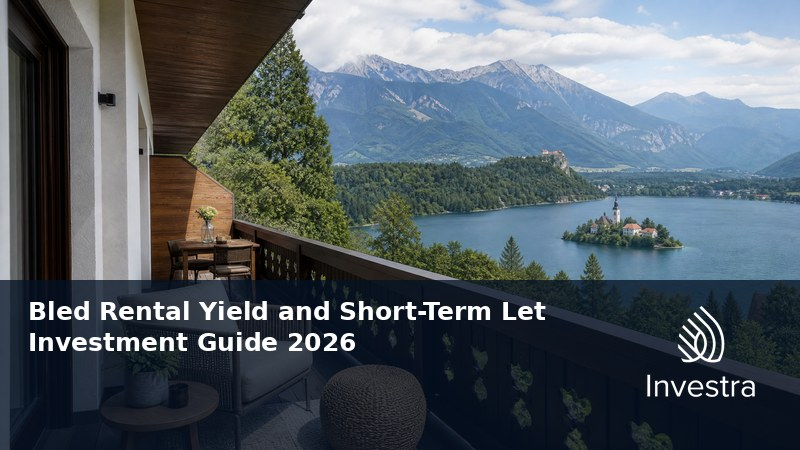
Bled consistently ranks among Europe's most beautiful destinations, with the glacial lake, cliff-top castle, and Julian Alps creating postcard-perfect scenery that translates directly into extraordinary tourism demand. What distinguishes Bled as an investment opportunity, however, is the underlying economic fundamentals driving that tourism rather than aesthetics alone.
Slovenia's EU membership since 2004 and eurozone adoption in 2007 eliminate currency risk entirely and establish legal frameworks, consumer protections, and banking standards at Western European levels. Bled's position 55 kilometres northwest of Ljubljana, with direct road connections to Austria and Italy, creates natural access patterns that drive consistent visitor flow.
The investor profile targeting Bled has shifted measurably over the past three years. Historically, the market was dominated by Slovenian nationals and occasional Austrian or German second-home purchasers. Today, serious enquiries originate from the UK, Netherlands, US, and Middle Eastern investors seeking stable EU-based assets.
Strong fundamentals don't guarantee investment success. Bled's market is geographically small, supply is constrained by strict planning regulations, and entry prices have risen substantially. Understanding where yields genuinely originate, how legal structures function, and the practical mechanics of ongoing management are prerequisites for protecting capital and achieving projected returns.
Bled Property Market Overview: Prices Per Square Metre in 2026
Quick Answer: Residential property in Bled currently trades at €3,500–€6,500/m² depending on location, condition, and lake proximity, representing a 40–60% premium over the Slovenian national average. Consulting resources like Siniša Dagary investment insight can help investors benchmark these figures against comparable Central European markets.
Pricing in Bled reflects genuine scarcity combined with sustained tourism demand. Since 2015, property values have followed a consistent upward trajectory, with particularly sharp acceleration evident post-2021. Vague pricing ranges serve investors poorly — specific data matters in investment decisions.
Lakefront and direct lake-view properties command €5,500–€6,500/m² for apartments and €4,800–€6,000/m² for houses depending on condition and plot size. These properties are rarely available and typically sell within weeks of listing.
Bled town and surrounding villages including Lesce, Bohinjska Bela, and Rečica range from €2,500–€3,800/m² for apartments and €2,200–€3,500/m² for houses. Lesce has emerged as particularly interesting due to its railway station offering direct connections to Ljubljana, creating opportunities in longer-stay digital nomad rentals alongside traditional tourism.
National context clarifies Bled's premium positioning. Slovenia's average residential property price nationally stands around €2,100–€2,400/m² as of 2026, with Ljubljana's prime central districts at €3,800–€5,500/m². Bled's lakefront premium over Ljubljana prime reaches 15–20%, reflecting genuine scarcity constraints — no additional lakefront acreage can be created.
Transaction volumes remain modest by European standards. The entire Bled municipality processes 80–150 residential transactions annually, meaning individual sales meaningfully move average statistics. Investors should treat any "average price" figure with appropriate scepticism and conduct detailed comparable sales analysis for specific property types and sub-locations.
Short-Term Rental Yields in Bled: The Airbnb Numbers That Matter
Quick Answer: Gross short-term rental yields in Bled range from 7–12% annually depending on property type and management quality, with net yields after costs and taxes typically landing at 4.5–7.5%. These figures significantly outperform long-term residential yields in most Slovenian cities.
Yield calculations in the short-term rental market require substantially more nuance than standard buy-to-let analysis. Gross yield figures alone can obscure critical cost structures and operational realities. Understanding the complete financial picture is essential for building accurate investment projections.
A representative example: a well-positioned 60m² two-bedroom apartment with lake views, purchased at €280,000–€320,000, generates realistic revenue as follows. During peak season (July–August), nightly rates reach €180–€280 with average occupancy of 28 nights out of 31, producing €5,000–€8,000 monthly. Shoulder season (May–June, September–October) yields €120–€180/night at 70–80% occupancy, generating €2,500–€4,000 monthly.
Annual gross rental income reaches €28,000–€42,000, translating to 9–13% gross yield on a €320,000 purchase. This represents genuinely strong returns by European standards — comparable Airbnb properties in Barcelona, Amsterdam, or Vienna often return 4–7% gross due to higher acquisition costs and more restrictive regulatory environments.
Operating costs materially reduce this headline figure. Platform fees (Airbnb and Booking.com) consume 3–15% depending on pricing strategy. Professional property management, essential for non-resident investors, typically costs 18–25% of revenue. Cleaning between stays runs €40–€80 per changeover. Utilities range €150–€300 monthly. Property insurance for short-term rental coverage costs €800–€1,500 annually.
After all operating costs but before income tax, net income typically falls in the €14,000–€22,000 range, producing 4.5–7% net pre-tax yields. After Slovenian income taxation (detailed subsequently), take-home yield for non-resident investors typically lands at 3.5–5.5%.
Legal Framework for Foreign Property Buyers in Slovenia
Quick Answer: EU/EEA citizens can purchase property in Slovenia with virtually no restrictions. Non-EU nationals face additional procedural requirements but can generally acquire property through Slovenian-registered companies. Slovenia's legal framework is transparent and EU-compliant, making it one of the more straightforward Central European markets for foreign investors.
Slovenia's property purchase process proves more straightforward than most investors anticipate, particularly for EU-domiciled buyers. The procedural sequence functions as follows.
EU/EEA nationals and residents possess purchase rights identical to Slovenian citizens. No special permits, no minimum holding periods, no property-type restrictions. The purchase mechanism mirrors standard Western European conveyancing procedures. Non-EU nationals including post-Brexit UK citizens, US investors, and UAE-based purchasers can acquire residential property, but additional procedural steps apply.
Slovenia operates a unified, digitised land registry system offering genuine reliability in title searches, significantly reducing legal risk present in some neighbouring Balkan markets. Notwithstanding this institutional strength, independent legal counsel remains essential — engage a local lawyer (odvjetnik/pravnik) for transaction review and advice. Budget €1,500–€3,000 for legal fees on typical residential acquisitions.
For investors understanding how technology is reshaping property transactions across the broader Central European region, the Investra.io analysis of Serbia PropTech developments provides useful context on digital transformation trends equally applicable to Slovenia's evolving market infrastructure and transaction efficiency.
Tax Obligations for Bled Property Investors: What You Actually Pay
Quick Answer: Property transfer tax in Slovenia is 2% of the agreed sale price. Rental income from short-term lets is taxed at a flat 25% rate on assessed income, with deductions available for operating costs. Annual property tax (nadomestilo za uporabo stavbnega zemljišča) is modest, typically €200–€600/year for residential properties in Bled.
Tax represents an area where international investors frequently encounter surprises or miss legitimate optimisation opportunities. Slovenia's tax framework demonstrates substantial clarity and comprehensive documentation, contributing meaningfully to its attractiveness relative to some regional alternatives.
Transaction taxes on acquisition include real estate transfer tax (davek na promet nepremičnin) of 2% on the purchase price, paid by buyers. New-build properties purchased from developers incur VAT (22% standard rate) instead of transfer tax — a consideration factoring into new-construction economics. Notary fees approximate 0.5–1% of transaction value.
Annual holding taxes consist of the land use charge (nadomestilo za uporabo stavbnega zemljišča, or NUSZ), functioning as Slovenia's annual property tax. This charge is calculated according to location, property size, and use category. For a typical Bled residential or tourist-purpose property, expect €300–€800 annually. This substantially undercuts comparable charges in Austria, Germany, or the United Kingdom.
Rental income taxation deserves particular attention for short-term let investors. Slovenia taxes STR income as business income when operated commercially — which STR fundamentally is. Individual property owners typically register as sole traders (s.p.) or operate through companies (d.o.o.). Under sole trader registration, a standardised expense deduction of 10% is available, with remaining income taxed at progressive rates (16%–50%). Alternatively, actual costs can be deducted, typically producing superior outcomes for actively managed properties. Corporate taxation via d.o.o. structures offers 19% corporate income tax, with additional planning possibilities surrounding dividend distribution. Optimal structuring depends on total income and residency classification — this warrants engagement with professional advisors like Siniša Dagary investment insight or qualified Slovenian tax professionals.
Capital gains trigger taxation on profits for properties sold within 5 years of acquisition, starting at 25% and declining progressively. After 20 years of ownership, capital gains tax reaches 0%. This step-down structure creates meaningful long-term holding incentives that many investors fail to incorporate into exit planning.
For financial services and accounting support tailored to Slovenian property investors, Findes Group & Partners provides specialist guidance for implementing effective investment structures.
Airbnb Regulation and Short-Term Let Rules in Bled 2026
Quick Answer: Slovenia requires all STR operators to register as tourism accommodation providers, obtain a categorisation certificate, and pay a tourist tax (turistična taksa) of €2–€3 per guest per night. Bled has not implemented the blanket STR bans seen in Barcelona or Amsterdam, but operator compliance requirements are strictly enforced.
Short-term rental regulation warrants careful attention given the rapidly evolving European policy environment. Encouragingly, Bled's regulatory framework remains genuinely permissive compared to most major European tourist destinations — though "permissive" emphatically does not mean "unregulated."
The tourist tax (turistična taksa) in Bled is currently €2.50 per adult per night, with reductions available for children and exemptions for specific categories. This tax is collected from guests and passed through to authorities — it does not reduce your rental revenue but represents a compliance obligation. Failure to collect and remit represents a genuine regulatory concern rather than a minor administrative formality.
Notably absent in Bled as of 2026 are the quantitative caps on STR nights (exemplified by London's 90-day rule or Amsterdam's 30-day limits) or primary residence requirements that have effectively eliminated investment-property STR categories in certain jurisdictions. Slovenia's Tourism Act requires proper categorisation but has not yet moved toward prohibition of investment-property short-term rentals.
Important signals warrant monitoring. The European Commission's Short-Term Rental Regulation (Regulation EU 2024/1028), implemented in 2024, obligates member states including Slovenia to establish data reporting frameworks by mid-2026. This transparency regarding STR volumes could enable municipalities to justify future restrictions.
Practically, Airbnb and Booking.com operating in Slovenia have adapted their platforms to collect tourist tax on behalf of hosts in most municipalities, substantially simplifying compliance. Bled is included in this automated collection infrastructure, meaningfully reducing administrative burden.
Best Property Types and Micro-Locations for Maximum Rental Yield
Quick Answer: Two-bedroom apartments with lake views within walking distance of the lake promenade consistently generate the highest yields in Bled. Alpine chalets and standalone villas offer higher absolute revenue but also higher entry costs and operating complexity, making yield optimisation more challenging.
Not all Bled properties perform equivalently in short-term rental markets. Location and property type interact meaningfully to determine financial outcomes, and assessments appearing attractive theoretically sometimes underperform upon guest experience examination.
Apartments in the €220,000–€380,000 acquisition range represent the most liquid and highest-yield investment category. Guests searching Bled accommodation on Airbnb and Booking.com frequently seek couples' retreats or small family experiences prioritising comfort, lake proximity, and convenience.
Standalone alpine chalets and traditional farmhouses (kozolec renovations representing traditional Slovenian agricultural structures) attract distinct, higher-spending guest segments. These properties command €250–€500/night peak-season pricing and generate impressive absolute revenue.
Properties near Vintgar Gorge and the southeastern lake shore have emerged as secondary micro-locations performing better than price positioning suggests. These locations, positioned slightly further from town centre, attract nature-focused guests specifically seeking quieter environments. Pricing runs 10–20% below lakefront comparables, yet occupancy rates remain surprisingly competitive.
Lesce village , technically a separate settlement 4km from Bled with independent railway station connectivity to Ljubljana, warrants mention as an emerging satellite location. Properties cost 30–40% less than Bled proper. Short-term rental opportunity is more modest (yields typically reach 6–8% gross), but the lower entry point enables investors with €150,000–€250,000 capital deployment to participate meaningfully.
Understanding how satellite and secondary locations offer compelling relative value — a dynamic evident across Central and Eastern European markets — provides context for broader portfolio strategy. The Aleksinac Real Estate Market 2026 Southern Serbia Property Guide explores comparable secondary-location dynamics in a different regional context, illustrating how value fundamentals operate across diverse market environments.
Financing a Bled Property Purchase: Mortgage Options and Capital Requirements
Quick Answer: Slovenian banks offer mortgages to EU citizens purchasing property in Slovenia, typically at 60–70% LTV for investment properties. Interest rates in early 2026 range from 3.8–5.2% for variable and fixed-rate products. Non-EU buyers typically need higher equity contributions or alternative financing structures.
Financing represents an area where Slovenia's EU membership delivers tangible practical benefits for EU-domiciled investors. Slovenian banks — including NLB, Nova KBM, and SKB Banka — are regulated under EU banking directives and actively offer mortgage products to qualifying EU residents purchasing Slovenian property.
Loan terms extend to 20–25 years for investment property. Monthly payments on a €200,000 mortgage at 4.2% over 20 years work out to approximately €1,230 — essential modelling to ensure properties generate positive cash flow from inception rather than requiring supplementary owner contributions.
Non-EU buyers face more complex financing landscapes. Most Slovenian banks require local residency or substantial banking relationships for mortgage approval. Consequently, many non-EU investors finance Bled acquisitions through: equity release or refinancing against existing property in home countries; private lending arrangements; or partnerships with EU-based co-investors.
One structural consideration deserves examination: property acquisition through d.o.o. (company) entities triggers commercial mortgage terms rather than residential ones. Commercial rates typically run 50–100 basis points higher, and LTV ratios are sometimes lower (50–65%). However, the tax and liability advantages of corporate ownership frequently outweigh marginally higher financing costs across complete investment cycles.
For investors constructing diversified Central European portfolios, understanding financing structures across multiple markets proves essential. The Sremska Mitrovica Real Estate 2026 Srem Region Property Guide and related market analyses offer useful comparative perspectives on investment structuring across neighbouring markets with different regulatory and financing environments.
Seasonal Dynamics and Occupancy Management: Making the Numbers Work Year-Round
Quick Answer: Bled's short-term rental market has become increasingly year-round, with winter occupancy supported by proximity to ski resorts and growing wellness tourism. Managing seasonal transitions effectively — through dynamic pricing and diverse guest targeting — is what separates 6% from 9%+ net yields.
A persistent misconception characterises Bled as purely summer-dependent destination. The 2026 reality proves considerably more nuanced, and understanding seasonal dynamics fundamentally determines investment case accuracy.
Summer (June–September) remains the undisputed demand peak. The lake achieves swimmable conditions (water temperatures reach 22–24°C in July–August), rowing boats operate, Bled Island reaches maximum photogenic appeal, and visitor volumes peak comprehensively. Properties should be priced aggressively during this window and occupancy maximised.
What has meaningfully changed over the past five years is winter performance. Proximity to Vogel ski area (40 minutes' drive), Kranjska Gora (30 minutes), and smaller resorts including Straža (literally 5 kilometres) creates legitimate winter occupancy opportunities previously underestimated. also, Bled has positioned itself as a wellness destination, attracting spa and retreat visitors during colder months.
Spring (April–May) and autumn (October) function as shoulder seasons with 70–80% occupancy achievable for well-positioned properties. These periods capture active tourism (hiking, climbing, cycling in adjacent Julian Alps) and increasingly attract remote-work guests utilising mountain environments for extended stays.
Revenue management sophistication drives yield superiority. Properties employing dynamic pricing — charging €280–€350/night in July–August, €150–€200 in May–June and September, €120–€160 in April and October, €90–€140 in winter months — capture maximum revenue from each segment while maintaining strong overall occupancy. Properties maintaining static pricing throughout the year leave 20–30% of potential revenue unrealised.
Property Management and Operational Excellence: The Difference Between Good and Great Returns
Quick Answer: Professional property management in Bled costs 18–25% of gross revenue but typically increases net income by 15–30% through optimised pricing, superior occupancy rates, and guest experience that drives repeat bookings and referrals. This is the most important determinant of actual versus theoretical returns.
The difference between properties returning projected yields and those underperforming comes down to management quality. Non-resident investors — which encompasses the majority of foreign buyers in Bled — cannot execute the granular operational decisions that drive returns without professional representation.
Costs run 18–25% of gross rental revenue, with variance reflecting property type, guest volume, and service intensity. A property generating €35,000 annually in gross revenue costs approximately €6,300–€8,750 for professional management.
When evaluating management companies, scrutinise historical performance data, guest review metrics, and references from existing clients. Request performance guarantees or performance-linked fee structures where available. Some of the highest-returning Bled properties are managed by individuals or small companies with 20–30 property portfolios who
Investment Disclaimer
Quick Answer: This guide is general market information, not personal legal, tax, financing or investment advice.
Before committing to a property transaction, buyers should obtain independent local legal, tax and financial advice suited to their circumstances. Investra.io can support initial market research, but every purchase decision remains the buyer's responsibility.
Frequently Asked Questions
Quick Answer: This section explains the practical property-investment implications of Frequently Asked Questions.
What is a prudent next step after initial market research?
Use current documentation, independent professional advice and comparable local evidence before proceeding. Investra.io can support an initial structured market review.
How can buyers plan a realistic ownership budget?
Use current documentation, independent professional advice and comparable local evidence before proceeding. Investra.io can support an initial structured market review.
What evidence supports a careful investment decision?
Use current documentation, independent professional advice and comparable local evidence before proceeding. Investra.io can support an initial structured market review.
When should a buyer obtain legal and tax advice?
Use current documentation, independent professional advice and comparable local evidence before proceeding. Investra.io can support an initial structured market review.
How should a buyer compare neighbourhoods and property types?
Use current documentation, independent professional advice and comparable local evidence before proceeding. Investra.io can support an initial structured market review.
What local checks should be completed before signing?
Use current documentation, independent professional advice and comparable local evidence before proceeding. Investra.io can support an initial structured market review.
Which costs should be assessed alongside the purchase price?
Use current documentation, independent professional advice and comparable local evidence before proceeding. Investra.io can support an initial structured market review.
How can international buyers verify a property opportunity?
Use current documentation, independent professional advice and comparable local evidence before proceeding. Investra.io can support an initial structured market review.
What should buyers compare before selecting a property?
Use current documentation, independent professional advice and comparable local evidence before proceeding. Investra.io can support an initial structured market review.
Quick Answer: These answers outline common buyer checks and should be read with current professional advice.
Recommended Reading
Quick Answer: This section explains the practical property-investment implications of Recommended Reading.
- Investra market research
- Investra market research
- Investra market research
- Investra market research
- Investra market research
- Investra market research
- Investra market research
- Investra market research
- Investra market research
- Investra market research
- Investra market research
- Investra market research
- Investra market research
- Investra market research
- Investra market research
- Investra market research
- Investra market research
- Siniša Dagary investment insight
- Siniša Dagary investment insight
- Siniša Dagary investment insight
- Siniša Dagary investment insight
- Siniša Dagary investment insight
- Findes Group & Partners
- Findes Group & Partners
Connect With Investra
Follow Investra for market updates on Facebook, LinkedIn, YouTube
Related Posts
No related posts available.
