
 Slovenia
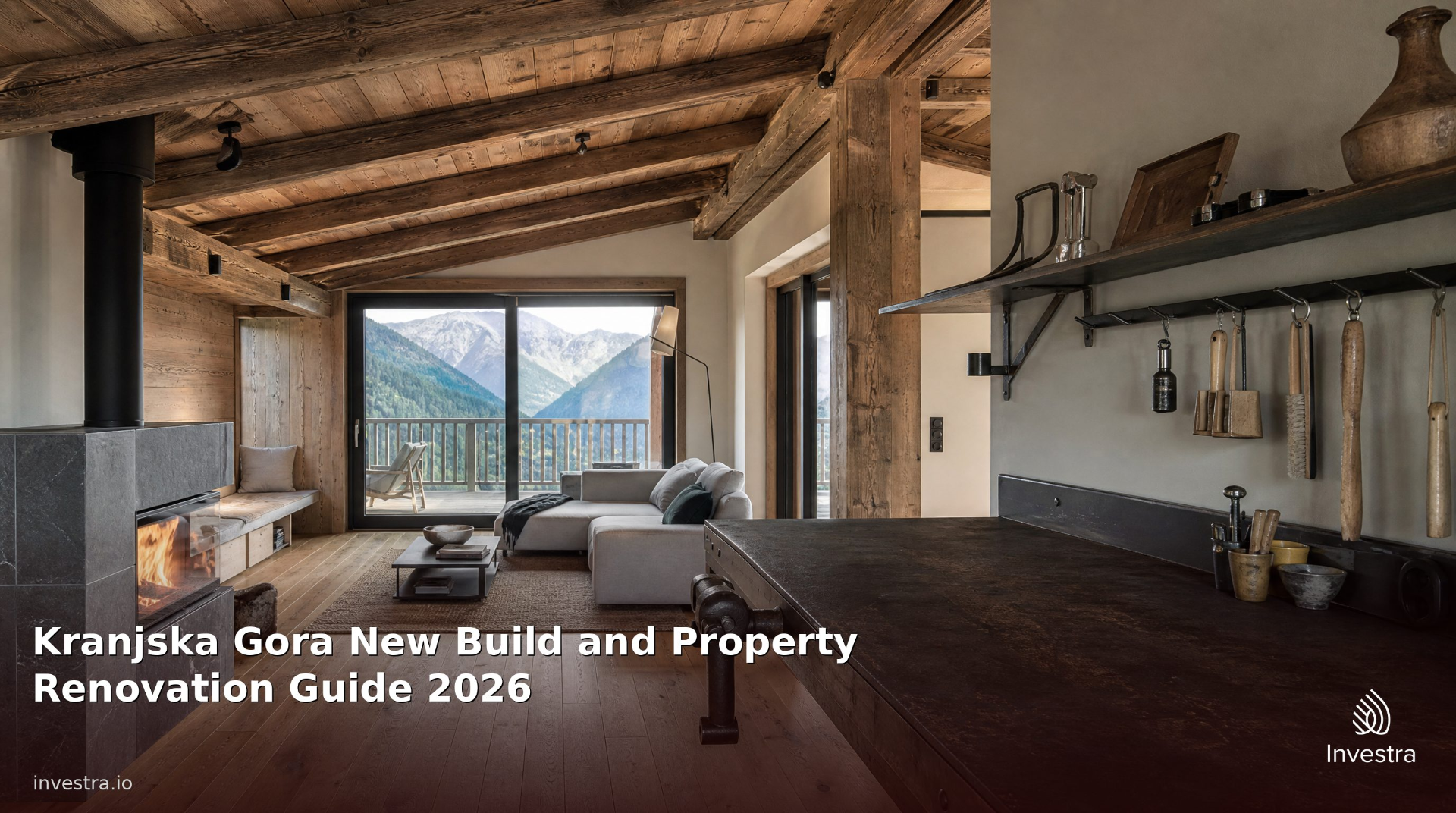
Kranjska Gora New Build and Property Renovation Guide 2026
Kranjska Gora New Build and Property Renovation Guide 2026
Kranjska Gora Real Estate Market Overview 2026: Why This Alpine Town Demands Attention
Quick Answer: Kranjska Gora is one of Slovenia's most sought-after alpine property markets in 2026, with new build prices ranging from €3,500 to €6,500/m² and renovation opportunities offering strong value uplift potential. Investra.io tracks emerging European markets including Slovenia's alpine corridor for international investors.
Tucked into the northwestern corner of Slovenia, where the Julian Alps form a dramatic natural barrier between Slovenia, Austria, and Italy, Kranjska Gora occupies a position that most real estate markets can only dream about. It's a year-round destination — ski resort in winter, hiking and cycling hub in summer — and the property market reflects exactly that dual-season magnetism.
What has happened to prices here over the past five years is remarkable. Between 2020 and 2025, residential property values in Kranjska Gora and the surrounding Gorenjska region increased by approximately 45–60%, significantly outpacing Slovenia's already-strong national average of around 38%.
As of 2026, the market has stabilized somewhat — but "stabilized" here means continued steady appreciation rather than any meaningful correction. New build apartments in the town center are trading at €4,500–€6,500/m², while standalone chalets and mountain houses command €3,800–€5,500/m² depending on condition, access, and proximity to the ski lifts.
The town itself has a permanent population of around 1,500 residents, but visitor numbers tell a very different story: over 500,000 tourists pass through annually, generating consistent demand for short-term rental accommodation. That's the fundamental investment thesis in Kranjska Gora — a tiny permanent market sitting beneath an enormous tourism superstructure.
New Build Construction in Kranjska Gora: Current Projects, Costs, and What's Actually Being Built
Quick Answer: New build construction in Kranjska Gora in 2026 is limited by strict planning regulations and protected alpine environment designations, making completed new-build units rare and premium-priced, typically between €4,500 and €6,500/m² for residential apartments.
Here's something that surprises many first-time buyers in this market: Kranjska Gora doesn't have the sprawling new development pipelines you might see in coastal Slovenia or in Ljubljana. The reason is simple — most of the land surrounding the town falls under protected area classifications, Triglav National Park buffers, or agricultural zoning that severely restricts new construction. That scarcity is precisely what underpins prices.
The new build projects that do get approved tend to be small-scale, boutique developments — typically 6 to 20 units — and they sell out quickly, often before the foundations are poured. In 2025–2026, several notable projects have reached the market or completion phase.
Construction costs for new builds in this region run between €1,400 and €2,200/m² for the building shell and structural work alone. Factor in alpine-grade insulation requirements (essential for energy efficiency in Slovenia's climate), high-quality interior finishes that the market demands, site preparation on often-complex mountain terrain, and developer margin — and you arrive at those €4,500–€6,500/m² retail prices easily.
Energy performance is non-negotiable in new Slovenian builds. The country has transposed EU energy performance directives comprehensively, meaning all new residential construction must meet at minimum energy class B requirements, with most premium developers targeting class A or A+.
For international buyers specifically, purchasing off-plan in Kranjska Gora requires careful due diligence on the developer's track record, planning permission status, and the structure of stage payments. Slovenia's Consumer Protection Against Building Contractor Act provides some buyer protections, but engaging a local lawyer who specializes in real estate before signing any reservation agreement is genuinely non-negotiable here.
Property Renovation in Kranjska Gora: Finding, Assessing, and Transforming Older Stock
Quick Answer: Renovation properties in Kranjska Gora can be acquired at €1,800–€3,200/m² with renovation budgets typically running €800–€1,500/m² for a full refurbishment, offering total all-in costs that are often 20–35% below comparable new-build pricing for similar end-quality outcomes.
The renovation opportunity in Kranjska Gora is real, and it's arguably more interesting from a pure investment standpoint than buying off-plan new build. What we've seen over the past few years is a growing cohort of international buyers — British, German, Austrian, and increasingly American — identifying older chalets and apartments that have been tired since the 1980s or 1990s and transforming them into premium short-term rental assets.
The value uplift equation works, but it demands discipline. The most common mistake buyers make is underestimating renovation costs in an alpine environment, or cutting corners on energy performance upgrades that would have both improved rental yields and future resale value.
Finding renovation properties requires local network access — many don't reach mainstream portals before being sold. Engaging a local real estate agent with genuine roots in the community, or working with an investment consultant experienced in Slovenian alpine property like Siniša Dagary investment insight, can make a meaningful difference in accessing off-market opportunities before they're widely known.
Planning Permissions, Building Regulations, and Environmental Constraints in Slovenia's Alpine Zone
Quick Answer: Kranjska Gora sits adjacent to Triglav National Park and within protected alpine landscape designations, making planning permissions more restrictive than most Slovenian markets — any renovation or new build project must comply with both national building codes and local spatial plans that often limit height, massing, and exterior materials.
Planning in Kranjska Gora isn't like planning in Ljubljana, Maribor, or even coastal Piran. The proximity to Triglav National Park and the broader alpine landscape protection regime creates a regulatory environment that's meaningfully more complex, and international buyers frequently underestimate this.
Slovenia's Spatial Planning Act (ZUreP-3), updated in recent years, together with the Building Act (GZ-1), governs all construction activity. At the local level, the Kranjska Gora municipality has its own spatial plan (Občinski prostorski načrt, or OPN) that designates land use, building envelopes, and architectural character requirements.
For new builds within or adjacent to the Triglav National Park buffer zone, the restrictions are particularly stringent. Height limits are typically one to two storeys above basement level, roof pitches must conform to local tradition (generally 35–45 degrees), and exterior materials must reference timber and stone rather than contemporary glass-and-steel aesthetics.
Legal Framework for International Buyers Purchasing Property in Slovenia
Quick Answer: EU citizens can purchase property in Slovenia on equal terms with Slovenian nationals; non-EU citizens face some additional requirements but can generally acquire residential property through established legal structures. Slovenia's property law is transparent and well-regulated, making it one of the more accessible European markets for international investors.
Slovenia has been an EU member since 2004 and adopted the euro in 2007, which immediately tells you something important about its regulatory environment: it's fully aligned with European standards of property law, consumer protection, and financial regulation. For buyers from other EU member states, the purchase process is essentially identical to what a Slovenian national would experience.
Non-EU buyers — Americans, British post-Brexit, Australians, and others — can purchase residential property in Slovenia, but the process involves additional steps. In many cases, non-EU nationals purchase through a Slovenian registered company (d.o.o. — the equivalent of a limited liability company), which bypasses some of the reciprocity requirements that apply to direct individual ownership.
The conveyancing process in Slovenia involves a notary (notar) who must authenticate the purchase agreement. Unlike some countries where lawyers handle everything, in Slovenia the notary plays a central role and their involvement is legally required.
For those building or developing property, additional considerations around building permits, construction supervision, and occupancy permits (uporabno dovoljenje) apply. No property can legally be rented or used for habitation without a valid occupancy permit — a detail that occasionally catches buyers off guard when purchasing incompletely documented properties. Always verify the documentation chain before signing anything.
If you're also looking at neighboring Balkan markets for portfolio diversification, the Loznica Real Estate Market 2026 Macva Region Property Guide offers useful context on how Serbia's legal framework for foreign buyers compares.
Taxes, Fees, and Transaction Costs for Property Buyers in Kranjska Gora
Quick Answer: The total transaction cost burden for property buyers in Slovenia is approximately 4–6% of purchase price, including 2% real estate transfer tax (or 9.5% VAT on new builds from VAT-registered developers), notary fees, legal costs, and registration charges — broadly competitive with Western European property markets.
Understanding the total cost of acquisition matters enormously when running investment calculations. Slovenia's transaction tax structure is reasonably clear, though it has a quirk that trips up buyers unfamiliar with the distinction: the tax you pay depends on whether you're buying from a VAT-registered entity or a private individual.
When purchasing a new build from a developer who is VAT-registered — which virtually all commercial developers are — the transaction is subject to 9.5% VAT (for residential properties under 120m² of usable floor area) or 22% VAT (for larger properties). This VAT is typically already embedded in the quoted sale price, but always confirm this with the developer.
For secondary market purchases (resale properties, including renovation projects from private sellers), a 2% real estate transfer tax (Davek na promet nepremičnin, or DPN) applies. This is paid by the buyer and is calculated on the higher of the purchase price or the assessed market value determined by the tax authorities — a mechanism designed to prevent significant under-reporting of prices.
Additional costs to budget include: notary fees (0.2–0.4% of transaction value, capped by official tariffs), legal fees for a buyer's lawyer (typically €1,500–€4,000 depending on transaction complexity), land register entry fees (modest, typically €50–€100), and real estate agent commission. In Slovenia, agent commissions are typically split between buyer and seller or are buyer-only at 2–3% plus VAT — always clarify this upfront.
Rental Yields and Investment Returns: What the Numbers Actually Show
Quick Answer: Short-term rental yields in Kranjska Gora typically range from 5.5% to 8.5% gross annually for well-positioned properties operated as alpine holiday rentals, with renovation projects delivering the strongest returns when the all-in acquisition and refurbishment costs are managed efficiently.
The rental yield question is where many investors' eyes light up — and for good reason. Kranjska Gora's dual-season tourism profile creates a revenue pattern that's unusual among European alpine markets. Most ski resorts are essentially dormant from April to November; Kranjska Gora is not.
At a purchase price of €250,000–€320,000 for such a property (either a quality renovation project or a smaller new-build unit), gross yields of 6–8.5% are achievable. Net yields — after management fees (typically 20–25% of gross for a professional short-term rental manager), utilities, maintenance allowances, insurance, and taxes — settle in the 4–6% range.
The renovation pathway specifically offers interesting return dynamics. Consider a property acquired at €180,000 and renovated for €90,000 (total all-in: €270,000). If that same property, post-renovation, generates €38,000 gross annually, the gross yield on total invested capital is 14.1%.
For comparison with emerging Balkan markets where the value dynamics are different but complementary to an alpine strategy, the Sremska Mitrovica Real Estate 2026 Srem Region Property Guide provides useful context on yield profiles in Serbia's Vojvodina region.
Financing Options for New Build and Renovation Projects in Slovenia
Quick Answer: Slovenian banks offer mortgages to EU residents and some non-EU nationals, typically at 60–70% loan-to-value ratios for foreign buyers, with current rates in the 4.2–5.8% range; specialist financial services firms like Findes Group & Partners can assist with structuring financing solutions for international property purchasers in Slovenia.
Financing a property purchase or renovation project in Kranjska Gora as an international buyer is genuinely achievable, though it requires more legwork than a domestic transaction. The Slovenian banking sector is solid — dominated by NLB (Nova Ljubljanska Banka), NKBM (Nova KBM), and Unicredit Bank Slovenia — and they have established frameworks for lending to EU nationals.
For EU residents purchasing in Slovenia, mortgage lending at up to 70–80% loan-to-value is possible, though in practice many lenders are more conservative with non-resident buyers, applying 60–70% LTV limits. Current Slovenian mortgage rates (early 2026) track the ECB rate environment with typical variable rates at 4.2–4.8% and fixed rates for 5–10 year periods at 4.5–5.8%.
For renovation-specific financing, Slovenian banks offer construction and renovation loan products (gradbeno posojilo) that release funds in tranches against construction progress. These products require detailed renovation budgets signed off by a certified construction manager (nadzornik), which is actually a useful discipline that helps prevent project overruns.
Non-EU buyers often find it more efficient to use equity from property in their home country or to use specialist international mortgage brokers who have relationships with Slovenian and other European lenders. Findes Group & Partners operates in the Slovenian market and can provide guidance on financing structures tailored to international buyers' circumstances. The cost of financing advice is invariably worthwhile given the complexity of cross-border mortgage arrangements.
Green renovation financing deserves a specific mention. Slovenia has been an active participant in EU Renovation Wave funding, and there are state-supported loan programs through the Eco Fund (Eko sklad) offering subsidized interest rates for energy efficiency upgrades — insulation, heat pumps, solar systems, triple glazing.
Choosing the Right Location Within the Kranjska Gora Area: Micro-Market Analysis
Quick Answer: The Kranjska Gora municipality encompasses several distinct micro-markets — Kranjska Gora town center, Podkoren, Rateče, Gozd Martuljek, and Mojstrana — each with different price points, rental dynamics, and development potential, requiring careful analysis before committing to a specific location.
The label "Kranjska Gora" covers more geographic territory than most outsiders appreciate, and where precisely you buy within the municipality has significant implications for price, rental yield, and renovation opportunity. Let's break this down clearly.
Kranjska Gora Town Center: The highest prices, the greatest tourist footfall, and the most restricted supply. This is where new-build apartments command €5,000–€6,500/m² and where renovation properties are scarce. Walk-to-ski-lifts and walk-to-restaurants are the premium drivers here. For short-term rental, occupancy rates are highest in the center, but yield compression from high acquisition costs is a real factor.
Podkoren: About 2km from the main center, this traditional village sits directly at the base of the Vitranc competition ski run — arguably the most famous race venue in Alpine skiing. What's interesting about Podkoren is that it retains more traditional character and has a slightly wider range of renovation candidates than the town center proper. Prices run €3,500–€5,200/m² for good properties, with renovation opportunities at €2,000–€3,000/m².
Rateče: At the westernmost point of Slovenia, essentially at the Italian and Austrian borders, Rateče is the most affordable part of the greater Kranjska Gora market. Prices here can drop to €2,200–€3,500/m² for residential properties. It's a quieter, more residential character and the rental yield profile is somewhat different — lower nightly rates but also lower acquisition costs.
Gozd Martuljek: A small settlement in the Martuljek gorge area, beloved by hikers and climbing enthusiasts. Very limited supply, but those properties that do trade here command strong prices from nature-focused buyers. Limited renovation stock but worth monitoring.
Mojstrana: Slightly outside the Kranjska Gora municipality proper, at the entrance to the Triglav National Park via the Vrata valley, Mojstrana offers the most affordable entry point in the wider area — €1,800–€2,800/m² — with significant renovation stock from older workers' housing. The investment thesis here is longer-term value appreciation and hiking/adventure tourism rental demand rather than ski-season premium income.
Working With Contractors and Architects: Practical Renovation Management Guide
Quick Answer: Successful renovation projects in Kranjska Gora depend on engaging experienced local contractors familiar with alpine building standards, maintaining detailed project supervision through a certified nadzornik, and implementing robust change management processes to prevent cost overruns in a tight regional labor market.
The difference between a renovation project that delivers on budget and one that spirals into cost overruns often comes down to contractor selection and project supervision. In Kranjska Gora, this distinction is particularly acute because specialized alpine tradespeople are scarce and command premium rates.
The first principle is to never — and we mean never — hire a contractor based solely on the lowest quote. Kranjska Gora has complex building requirements: high-altitude weather exposure, steep terrain logistics, strict heritage conservation rules, and energy performance mandates. Contractors who have completed successful renovations in this specific environment are worth a material premium over generalist builders from the lower reaches of Slovenia.
Once you've identified potential contractors, reference checks aren't optional — they're fundamental due diligence. Speak directly to previous clients, visit completed properties, and verify the contractor's compliance record with the Building Inspection Service (Gradbena inšpekcija).
The role of the certified construction manager (nadzornik) cannot be overstated. Under Slovenian law, all renovation projects above certain value thresholds require professional on-site supervision by a certified supervisor. Rather than viewing this as a cost burden, treat it as insurance.
For international clients managing projects remotely, the nadzornik becomes even more critical. They're not just a supervisor; they're your eyes and ears. A good supervisor will provide weekly photo documentation, budget tracking, and early warning when issues are emerging. Budget €100–€200/day
Investment Disclaimer
Quick Answer: This guide is general market information, not personal legal, tax, financing or investment advice.
Before committing to a property transaction, buyers should obtain independent local legal, tax and financial advice suited to their circumstances. Investra.io can support initial market research, but every purchase decision remains the buyer's responsibility.
Frequently Asked Questions
Quick Answer: This section explains the practical property-investment implications of Frequently Asked Questions.
What is a prudent next step after initial market research?
Use current documentation, independent professional advice and comparable local evidence before proceeding. Investra.io can support an initial structured market review.
How can buyers plan a realistic ownership budget?
Use current documentation, independent professional advice and comparable local evidence before proceeding. Investra.io can support an initial structured market review.
What evidence supports a careful investment decision?
Use current documentation, independent professional advice and comparable local evidence before proceeding. Investra.io can support an initial structured market review.
When should a buyer obtain legal and tax advice?
Use current documentation, independent professional advice and comparable local evidence before proceeding. Investra.io can support an initial structured market review.
How should a buyer compare neighbourhoods and property types?
Use current documentation, independent professional advice and comparable local evidence before proceeding. Investra.io can support an initial structured market review.
What local checks should be completed before signing?
Use current documentation, independent professional advice and comparable local evidence before proceeding. Investra.io can support an initial structured market review.
Which costs should be assessed alongside the purchase price?
Use current documentation, independent professional advice and comparable local evidence before proceeding. Investra.io can support an initial structured market review.
How can international buyers verify a property opportunity?
Use current documentation, independent professional advice and comparable local evidence before proceeding. Investra.io can support an initial structured market review.
What should buyers compare before selecting a property?
Use current documentation, independent professional advice and comparable local evidence before proceeding. Investra.io can support an initial structured market review.
Quick Answer: These answers outline common buyer checks and should be read with current professional advice.
Recommended Reading
Quick Answer: This section explains the practical property-investment implications of Recommended Reading.
- Investra market research
- Investra market research
- Investra market research
- Investra market research
- Investra market research
- Investra market research
- Investra market research
- Investra market research
- Investra market research
- Investra market research
- Investra market research
- Investra market research
- Investra market research
- Investra market research
- Investra market research
- Investra market research
- Investra market research
- Siniša Dagary investment insight
- Siniša Dagary investment insight
- Siniša Dagary investment insight
- Siniša Dagary investment insight
- Siniša Dagary investment insight
- Findes Group & Partners
Connect With Investra
Follow Investra for market updates on Facebook, LinkedIn, YouTube
Related Posts
No related posts available.
