
 Slovenia
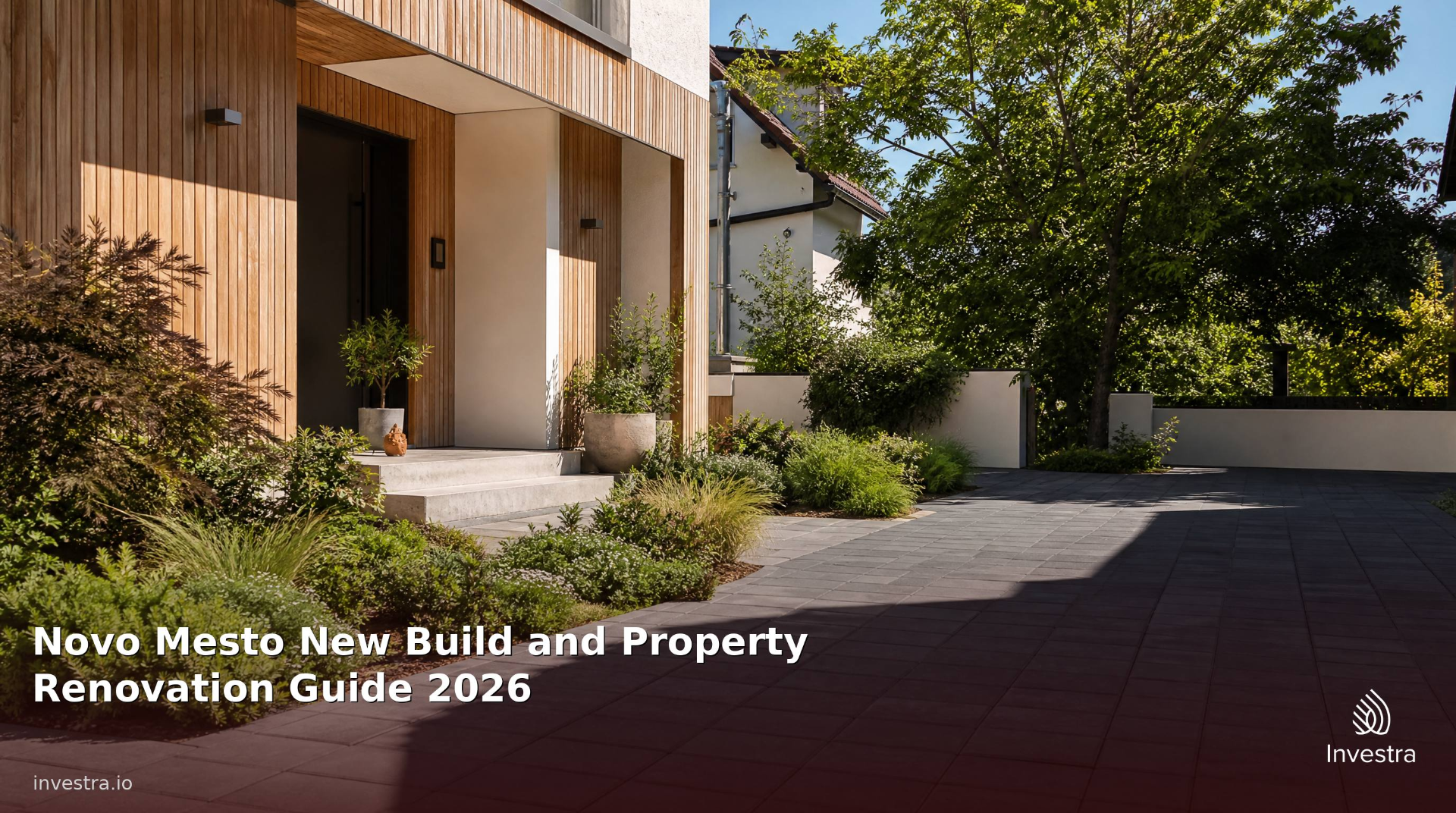
Novo Mesto New Build and Property Renovation Guide 2026
Novo Mesto New Build and Property Renovation Guide 2026
Novo Mesto New Build and Renovation Market: What's Happening in 2026
Quick Answer: Novo Mesto's new build and renovation market in 2026 is experiencing steady growth, with new construction prices ranging from €2,200 to €3,800/m² and renovation costs between €400 and €1,200/m² depending on scope and location. Investra.io tracks emerging property markets across the region to help investors make data-driven decisions.
Novo Mesto doesn't always make international headlines the way Ljubljana or Bled do — and that's precisely why savvy investors are paying attention. The capital of the Dolenjska region sits at the confluence of the Krka River and centuries of Central European history, yet it functions today as a modern industrial and pharmaceutical hub.
The reality is that 2026 looks different from even three years ago. Post-pandemic demand shifts, rising construction costs across the EU, and Slovenia's steady population growth in secondary cities have all converged to make Novo Mesto a legitimate investment destination.
What surprised many buyers who looked at this market in 2024 and 2025 was the speed of price appreciation. Novo Mesto saw average residential prices climb roughly 8–11% year-on-year during that period, outpacing several larger Slovenian cities on a percentage basis.
For international investors exploring Balkan and Central European property markets, Novo Mesto represents something relatively rare: a city with genuine economic fundamentals, limited new supply, and a renovation stock that's still undervalued relative to Western European equivalents. The platform Serbia Proptech 2026 How Technology Is Changing Real Estate has explored how digital tools are reshaping property research across the region — and those same tools are making markets like Novo Mesto increasingly accessible to remote buyers.
Understanding Novo Mesto's Property Landscape: Old Town, Suburbs, and Growth Corridors
Quick Answer: Novo Mesto's property market divides broadly into the historic Breg and Kandija old-town areas, established residential suburbs like Bršljin and Šmihel, and newer growth corridors along the Krka valley — each with distinct price points, renovation potential, and buyer profiles.
Geography shapes everything in Novo Mesto. The old town peninsula — a dramatic loop of the Krka River — creates a natural boundary that gives the city its distinctive character but also caps available land. Understanding the city's districts before buying is not a formality; it's essential to knowing what you're actually getting into.
Move outward to Bršljin, Šmihel, or Ragov Log, and you encounter a very different product: post-war and socialist-era apartment blocks, many in decent structural condition but cosmetically dated. These are the renovation sweet spots. Purchase prices in these areas run €1,600–€2,200/m² for unrenovated stock, and renovation costs of €500–€900/m² can push finished values to €2,500–€2,900/m².
The emerging growth corridors deserve particular attention. The western approach along route E70 and the areas near the Revoz plant have seen small-scale industrial-to-residential conversions, and the municipality of Novo Mesto has zoned several parcels for new residential development in the Šmihel and Brod areas.
Consulting resources like Siniša Dagary investment insight can help international buyers map district-level opportunities against their own risk appetite and capital structure, particularly when choosing between renovation-heavy old town projects and lower-complexity new build acquisitions in growth corridors.
New Build Property Prices in Novo Mesto 2026: What You'll Actually Pay
Quick Answer: New build apartments in Novo Mesto in 2026 are priced between €2,200 and €3,800/m², with entry-level units in outer districts starting around €2,200/m² and premium new builds in central or riverfront locations reaching €3,500–€3,800/m².
Let's talk numbers, because vague optimism doesn't pay mortgages. The new build market in Novo Mesto in 2026 is segmented fairly clearly by location, specification level, and developer reputation.
At the accessible end, new apartments in suburban locations — think Šmihel, Bršljin extended zone, or the Ragov Log corridor — are launching at €2,200–€2,600/m². These are typically 2–3 bedroom units with standard EU-compliant energy efficiency ratings (A or B class), underground parking, and basic finishes.
Mid-range new builds, often in infill sites closer to the city center or with elevated specifications — better sound insulation, underfloor heating, high-quality kitchen and bathroom packages — sit at €2,700–€3,200/m². This is the most active price band currently, where demand from local professionals and young families is strongest. A 75 m² unit here carries a price tag of approximately €202,500–€240,000.
Premium new construction in the old town fringe or with Krka River views commands €3,200–€3,800/m², occasionally exceeding that threshold for truly exceptional projects. These developments are relatively rare given land constraints, and when they come to market, absorption is usually quick.
Construction cost inflation has been a persistent headache for developers across Slovenia since 2022, with materials costs remaining elevated even as supply chains normalized somewhat. Labor in Novo Mesto is slightly cheaper than Ljubljana but not dramatically so, and skilled trades remain in short supply across the country.
Renovation Costs and Opportunities in Novo Mesto: A Practical Breakdown
Quick Answer: Renovation costs in Novo Mesto range from €400/m² for light cosmetic work to €1,200/m² or more for full structural renovation of heritage properties, with the most common investor renovation — full interior refurbishment of a socialist-era apartment — typically running €600–€900/m².
Renovation is where the real opportunity lies for patient, hands-on investors. Slovenia's existing residential stock in secondary cities like Novo Mesto includes thousands of apartments built between 1950 and 1990 that are structurally sound but functionally obsolete by modern living standards.
Here's a realistic cost breakdown for the most common renovation scenarios in 2026:
Light renovation (cosmetic only — paint, flooring, fixtures): €400–€550/m². A 60 m² apartment costs €24,000–€33,000 to refresh. This approach works best for units already in decent structural and systems condition, typically built after 1975.
Mid-range renovation (new kitchen and bathrooms, updated electrics and plumbing, new windows, flooring throughout): €600–€850/m². For that same 60 m² unit, expect to spend €36,000–€51,000. This is the standard investor renovation package and typically delivers the best value uplift relative to cost.
Full renovation including structural work: €900–€1,200/m², and potentially beyond for heritage-listed properties requiring specialist craftspeople. At this level, you're essentially rebuilding interiors and sometimes reinforcing structure, which means project timelines extend to 9–18 months and contingency budgets need to be real, not theoretical.
What we've seen consistently is that investors who skip proper due diligence on structural condition tend to discover expensive surprises mid-project. Pre-purchase structural surveys in Slovenia cost roughly €300–€600 and are worth every cent.
Comparing renovation economics to other regional markets is instructive. Looking at markets like those covered in our Zajecar Real Estate Market 2026 Eastern Serbia Property Guide, you'll find that purchase prices may be lower across the border, but Slovenia's stronger rental market, legal certainty, and eurozone status often make the net return calculus favor Novo Mesto for risk-adjusted investors.
Legal Framework for Foreign Buyers: Buying Property in Slovenia as a Non-Resident
Quick Answer: EU citizens can buy property in Slovenia with virtually no restrictions, while non-EU nationals face additional requirements including residency status checks or bilateral agreement provisions — but the process remains one of the most transparent and legally secure in the broader Balkan-Central European region.
Slovenia's legal framework for property ownership is robustly EU-aligned, which matters enormously for investor confidence. The country joined the EU in 2004, adopted the euro in 2007, and integrated into Schengen in the same year.
For EU/EEA citizens, the process is straightforward: you can buy residential or commercial property outright, in your own name or through a company, without any specific governmental approval. The transaction proceeds through a notarial deed, registration in the land cadastre (Zemljiška knjiga), and payment of real estate transfer tax.
Non-EU nationals face a two-track system. Those with legal Slovenian residency (temporary or permanent) can buy property on the same terms as EU citizens. Those without Slovenian residency must rely on bilateral agreements between Slovenia and their home country — and Slovenia has concluded such agreements with a significant number of non-EU states.
The Findes Group & Partners platform offers financial structuring guidance for property transactions in Slovenia, including mortgage options and financing structures relevant to both local and international buyers.
Taxes, Fees, and the True Cost of Buying in Novo Mesto
Quick Answer: The total acquisition cost for a property purchase in Novo Mesto typically adds 4–7% to the purchase price, covering real estate transfer tax (2%), notary fees, land registry fees, and agent commissions — with VAT replacing transfer tax on new builds from developers registered for VAT purposes.
Transaction costs in Slovenia are manageable by European standards, but they need to be factored into investment modeling from day one. Here's a complete breakdown of what you'll actually pay beyond the purchase price.
Real Estate Transfer Tax (DURS): 2% of the agreed purchase price, payable by the buyer within 30 days of transaction completion. This applies to secondary market transactions. For new builds purchased directly from a VAT-registered developer, the 2% DPN is replaced by 9.5% VAT (included in the purchase price and paid by the developer to the state — but you're absorbing it in the price).
Notary fees: Scaled by transaction value, typically €400–€1,500 for residential transactions in the €150,000–€400,000 range. Both parties usually share notary costs, though this is negotiable.
Land Registry fee: Approximately €50–€150 for standard registration.
Real estate agent commission: Typically 2–4% plus VAT (22%), usually shared between buyer and seller or paid entirely by one party depending on the agreement. Novo Mesto has active local agencies, and it's possible to negotiate this.
Legal fees: If using an attorney for contract review and transaction management (recommended for international buyers), budget €800–€2,500 depending on complexity.
On the ongoing tax side, Slovenia levies a real property tax (Nadomestilo za uporabo stavbnega zemljišča — NUSZ) that is set by municipalities and varies, but typically runs €100–€500 per year for a standard apartment. Rental income is taxed at a flat 25% rate (with a 10% standardized expense deduction, so the effective rate is 22.5% of gross rent).
The Siniša Dagary investment insight page provides context on investment consultancy for regional markets, including Slovenia, where tax optimization structuring through corporate ownership can materially improve after-tax returns.
Rental Yields and Investment Returns in Novo Mesto 2026
Quick Answer: Gross rental yields in Novo Mesto range from 4.5% to 6.8% in 2026, with the best returns found in well-renovated mid-range apartments near Krka Pharmaceuticals and the city center, while net yields after tax and costs typically settle between 3.2% and 5.1%.
Yield data for Novo Mesto is sometimes harder to find than for Ljubljana, but that information gap itself creates opportunity for well-researched investors. What we know from market participants, local agency data, and municipal rental statistics paints a fairly consistent picture.
The rental market in Novo Mesto is primarily demand-driven by three distinct tenant groups: Krka and Revoz employees (stable, long-term, often corporate-leased), students at the Faculty of Organizational Sciences and other Novo Mesto educational institutions, and relocating professionals from Ljubljana who are priced out of the capital but need commutable access via the A2 motorway.
Monthly rental rates for a standard renovated two-bedroom apartment (60–70 m²) in a central-to-midtown location run €650–€900. A renovated one-bedroom unit commands €500–€700/month. Three-bedroom family apartments in good condition reach €900–€1,300/month.
For renovation-focused investors, the return calculation includes a capital uplift component. An apartment bought for €100,000 (unrenovated, 60 m²) in Bršljin, renovated for €50,000, and valued post-renovation at €165,000–€175,000, represents a 10–15% ROI on total invested capital before rental income — and then continues generating 4.5–5.5% gross yield on the improved asset.
Comparing this against markets explored in our Sremska Mitrovica Real Estate 2026 Srem Region Property Guide, Novo Mesto offers lower gross yields but significantly stronger legal protection, eurozone stability, and liquidity — important considerations for investors prioritizing capital preservation alongside income.
Building Permits, Planning Regulations, and Heritage Considerations
Quick Answer: Building permits in Novo Mesto are issued by the municipality's building inspectorate and typically take 2–6 months for straightforward residential projects, though heritage-listed properties and complex renovations can extend timelines significantly — making pre-purchase planning consultation essential.
Slovenia's building regulation framework underwent significant reforms with the Building Act (Gradbeni zakon) amendments of 2021 and subsequent updates. The system is cleaner than it was a decade ago, but it still demands respect from investors unfamiliar with it.
Renovation is where complexity multiplies. Minor internal works that don't affect load-bearing structure, fire safety, or building envelope technically don't require permits — but the definition of "minor" is strict and often misunderstood.
Heritage properties in the old town core are subject to the Cultural Heritage Protection Act and require approval from the Institute for the Protection of Cultural Heritage of Slovenia (ZVKDS) for any exterior modifications and often for significant interior changes. This adds 3–6 months to renovation timelines in the best case and imposes material constraints on what you can actually do to the building.
Working with a local architect who has experience with both municipal planning and ZVKDS approval processes is not optional for heritage projects — it's genuinely essential. Architect fees for renovation project management in Novo Mesto run approximately 8–12% of construction cost, which should be treated as mandatory professional investment, not an optional overhead.
Financing Options for New Builds and Renovations in Novo Mesto
Quick Answer: Slovenian banks offer mortgage financing to both residents and eligible non-residents, with current interest rates for residential mortgages at 4.2–5.8% (variable) and 5.0–6.5% (fixed) in 2026, while renovation financing is available through a combination of bank loans, EU structural funds, and state subsidy programs.
Financing a property purchase or renovation in Novo Mesto involves handling a range of instruments — and the good news is that Slovenia's banking sector is relatively sophisticated and internationally accessible compared to many regional neighbors.
Major Slovenian banks including NLB (Nova Ljubljanska Banka), SKB (part of OTP Group), Gorenjska Banka, and Intesa Sanpaolo Slovenia all offer residential mortgages. For EU resident buyers with verifiable income, loan-to-value ratios of 70–80% are typical.
Current (2026) variable rate mortgages are tied to EURIBOR (12-month) plus bank margin, landing in the 4.2–5.8% range for most qualified borrowers. Fixed-rate options for 10–20 year terms run 5.0–6.5%.
EU structural and cohesion funds, channeled through Slovenian national programs, provide additional grant funding for renovation of housing in designated regeneration zones. Parts of Novo Mesto's older residential areas fall within such zones. Accessing this funding requires patience and bureaucratic endurance, but the capital available makes it worthwhile for larger renovation projects. Platforms like Siniša Dagary investment insight cover EU funding navigation strategies relevant to property investors in Central and Southeast Europe.
Choosing the Right Developer or Contractor in Novo Mesto
Quick Answer: Selecting a reputable developer or contractor in Novo Mesto requires verification through the Slovenian Business Register (AJPES), review of completed project portfolios, inspection of reference properties, and confirmation of required licenses and insurance — a process that typically takes 4–8 weeks but prevents catastrophic mid-project failures.
The developer and contractor selection decision is arguably more consequential than the property selection itself. A good contractor can salvage a mediocre property; a poor contractor will destroy a good one. In Novo Mesto, where the developer and contractor ecosystem is smaller than in Ljubljana but increasingly professional, thorough vetting is non-negotiable.
Start with the Slovenian Business Register (AJPES). Every legitimate developer and contractor is registered there, and you can verify company status, shareholder information, and financial history.
For new build developers, request references to three completed projects — and actually visit those projects. Speak with residents about construction quality, delivery timeliness, and post-completion responsiveness to defects. Check municipal building department records to see whether the developer has a history of permit violations or completion delays. Many of these records are now publicly accessible.
Construction contractors for renovation projects should carry Slovenian liability insurance (zavarovanje odgovornosti) and professional insurance (poklicna zavarovanja) — demand proof of both. Their quotes should be itemized by trade and material, not provided as opaque lump sums.
Written contracts in Slovenian are essential even for English-language transactions. The contract should specify materials, equipment specifications, timeline with penalties for delays, staged payment terms (typically 10–20% on signing, progress payments as work advances, final payment only after completion and inspection), and a detailed defects list and remediation timeline.
Market Risks and Mitigation Strategies for Novo Mesto Property Investment
Investment Disclaimer
Quick Answer: This guide is general market information, not personal legal, tax, financing or investment advice.
Before committing to a property transaction, buyers should obtain independent local legal, tax and financial advice suited to their circumstances. Investra.io can support initial market research, but every purchase decision remains the buyer's responsibility.
Frequently Asked Questions
Quick Answer: This section explains the practical property-investment implications of Frequently Asked Questions.
What is a prudent next step after initial market research?
Use current documentation, independent professional advice and comparable local evidence before proceeding. Investra.io can support an initial structured market review.
How can buyers plan a realistic ownership budget?
Use current documentation, independent professional advice and comparable local evidence before proceeding. Investra.io can support an initial structured market review.
What evidence supports a careful investment decision?
Use current documentation, independent professional advice and comparable local evidence before proceeding. Investra.io can support an initial structured market review.
When should a buyer obtain legal and tax advice?
Use current documentation, independent professional advice and comparable local evidence before proceeding. Investra.io can support an initial structured market review.
How should a buyer compare neighbourhoods and property types?
Use current documentation, independent professional advice and comparable local evidence before proceeding. Investra.io can support an initial structured market review.
What local checks should be completed before signing?
Use current documentation, independent professional advice and comparable local evidence before proceeding. Investra.io can support an initial structured market review.
Which costs should be assessed alongside the purchase price?
Use current documentation, independent professional advice and comparable local evidence before proceeding. Investra.io can support an initial structured market review.
How can international buyers verify a property opportunity?
Use current documentation, independent professional advice and comparable local evidence before proceeding. Investra.io can support an initial structured market review.
What should buyers compare before selecting a property?
Use current documentation, independent professional advice and comparable local evidence before proceeding. Investra.io can support an initial structured market review.
Quick Answer: These answers outline common buyer checks and should be read with current professional advice.
Recommended Reading
Quick Answer: This section explains the practical property-investment implications of Recommended Reading.
- Investra market research
- Investra market research
- Investra market research
- Investra market research
- Investra market research
- Investra market research
- Investra market research
- Investra market research
- Investra market research
- Investra market research
- Investra market research
- Investra market research
- Investra market research
- Investra market research
- Investra market research
- Investra market research
- Investra market research
- Siniša Dagary investment insight
- Siniša Dagary investment insight
- Siniša Dagary investment insight
- Siniša Dagary investment insight
- Siniša Dagary investment insight
- Findes Group & Partners
- Findes Group & Partners
Connect With Investra
Follow Investra for market updates on Facebook, LinkedIn, YouTube
Related Posts
No related posts available.
