
 Slovenia
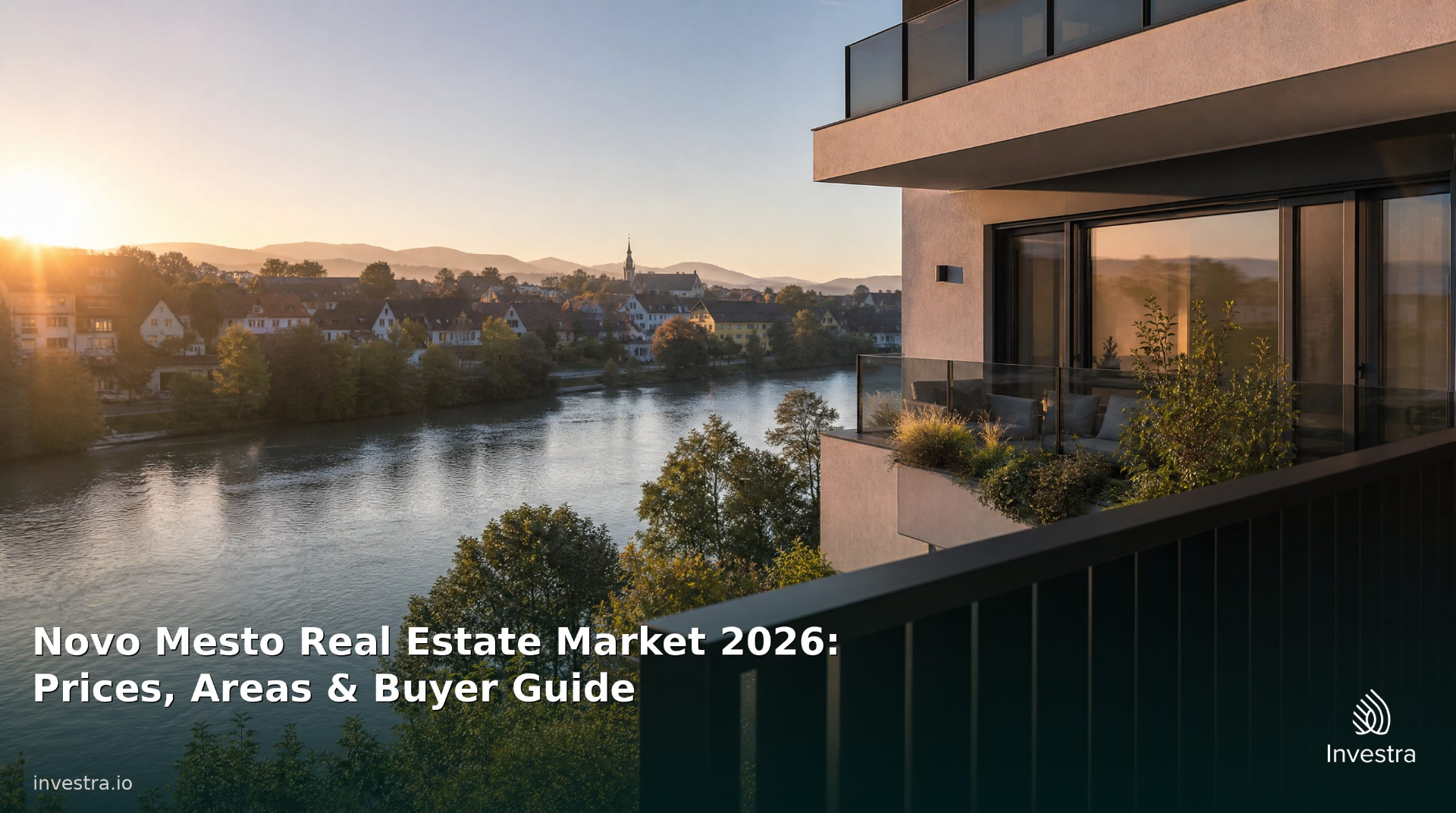
Novo Mesto Real Estate Market 2026: Prices, Areas & Buyer Guide
Novo Mesto Real Estate Market 2026: Prices, Areas & Buyer Guide
Novo Mesto Real Estate Market 2026: An Overview of Slovenia's Industrial Heartland
Quick Answer: Novo Mesto's real estate market in 2026 is characterized by steady price growth, strong industrial employment, and rising demand from both domestic buyers and international investors attracted by Slovenia's eurozone stability and EU membership. Investra.io provides comprehensive market data and investment tools to help buyers make informed decisions across Central and Eastern European markets.
Novo Mesto sits in the southeastern corner of Slovenia, straddling the Krka River and nestled among rolling hills that define the Dolenjska region. It's a city that doesn't shout about itself — and yet, for anyone paying attention to Slovenian real estate, it keeps appearing on the radar for all the right reasons.
The reality is that Novo Mesto punches well above its weight. Unemployment rates here hover consistently below the Slovenian national average — which itself is enviably low by European standards. This employment stability translates directly into a healthy real estate market where demand is structurally supported rather than speculative.
In 2026, the Slovenian property market at large continues to recover from the brief cooling period that followed ECB rate hikes in 2022–2023. Novo Mesto, insulated by its industrial base, never experienced the sharp corrections seen in purely residential markets like coastal Piran or ski resort areas.
Understanding Novo Mesto's Economic Foundations and Their Impact on Property Demand
Quick Answer: Novo Mesto's economy is anchored by Krka Pharmaceuticals and the Revoz/Renault manufacturing plant, creating consistent employment demand that keeps residential property vacancy rates low and rental demand structurally elevated throughout the city. Comparing Novo Mesto to other industrial cities in the region highlights how a diversified employer base significantly reduces real estate investment risk.
Understanding why Novo Mesto's property market behaves the way it does requires understanding its economic DNA. Krka Pharmaceuticals alone employs over 5,000 people in Novo Mesto and generates annual revenues exceeding €1.7 billion.
Revoz, the Renault-owned car manufacturing facility that produces models like the Twingo and Clio, employs approximately 3,000 workers directly. The automotive supply chain around it adds thousands more jobs in the broader region.
What this means practically for property investors: vacancy rates for well-located residential properties in Novo Mesto remain consistently below 5%, which is exceptional by Central European standards. The tenant base skews heavily toward employed professionals rather than students or seasonal workers, meaning lower turnover and more predictable rental income streams. Professionals working with Siniša Dagary investment insight regularly cite employment stability as the primary reason they recommend Novo Mesto to risk-conscious investors seeking Slovenian market exposure.
Novo Mesto Property Prices Per Square Meter in 2026
Quick Answer: Property prices in Novo Mesto range from approximately €1,800 to €3,500 per square meter in 2026 depending on location, property type, and condition, with new-build apartments in central areas commanding the upper end of that range. For comparative context across regional markets, Investra.io's database tracks price movements across dozens of Central and Eastern European cities simultaneously.
Let's get into the numbers, because that's ultimately what drives investment decisions. Novo Mesto's property market in 2026 presents a clear pricing hierarchy based on location, age of building, and proximity to key employment centers.
New-build apartments in central Novo Mesto: These are commanding between €2,800 and €3,500 per square meter. The most prestigious new developments near Glavni trg (the main square) and along the Kandijska cesta corridor have seen prices touch €3,800/m² for penthouse units with panoramic views over the Krka River valley.
Resale apartments in urban neighborhoods: This is the bulk of the market. Well-maintained resale flats in neighborhoods like Bršljin, Gotna vas, and Ragov Log typically trade between €2,000 and €2,600 per square meter.
Houses and family homes: Standalone family houses on the outskirts — in areas like Stopiče, Šmihel, and Ločna — range from €180,000 to €420,000 depending on land area and condition. Per-square-meter pricing for houses typically falls between €1,600 and €2,800/m² for habitable stock.
Commercial and investment properties: Smaller commercial units in the city center (retail, office space up to 200m²) trade between €1,500 and €2,500/m² with capitalization rates of 5.5–7.5%, making them genuinely attractive for income-focused investors. The industrial property market around the Krka and Revoz supply zones sees warehousing and light industrial units transact at €600–€900/m².
Price growth trajectory: the GURS (Slovenian Surveying and Mapping Authority) data for 2024–2025 shows Novo Mesto residential property appreciated approximately 5.8% annually on a price-per-square-meter basis — marginally below Ljubljana's 7.2% but with considerably lower entry prices and stronger rental yield fundamentals.
Best Neighborhoods to Buy Property in Novo Mesto
Quick Answer: The city center (Staro Mestno Jedro) and the Ločna district offer the best balance of rental demand and capital appreciation potential, while Kandija and Šmihel appeal to buyers seeking larger family homes at more accessible price points. Understanding neighborhood dynamics is essential for optimizing returns in any regional property market.
Novo Mesto isn't a large city, but its neighborhoods have distinct characters and investment profiles that matter enormously when you're selecting a specific asset.
Staro Mestno Jedro (Old Town Core): This is the historic heart of the city, perched on a promontory overlooking the Krka River. Properties here are predominantly older buildings — some dating to the 17th and 18th centuries — that have been converted into apartments or remain as family residences.
Ločna: This is arguably the most in-demand residential neighborhood for the professional class employed at Krka and Revoz. Well-planned with green spaces, good schools, and modern amenities, Ločna attracts families and young professionals alike. New construction here has been active, with several developments completed in 2024–2025 offering modern apartments with underground parking.
Kandija: A mixed-use neighborhood with a blend of older apartment blocks and newer detached houses. The proximity to the A2 motorway interchange makes it practical for commuters, and the presence of the Krka factory complex nearby keeps rental demand strong. Entry prices are somewhat lower than Ločna, making it accessible for first-time investors.
Gotna Vas and Bršljin: These are more affordable neighborhoods with a mix of panel-era apartment blocks and newer infill development. Value-add opportunities are more prevalent here, and gross rental yields can be slightly higher (6–7.5%) precisely because acquisition prices are lower relative to achievable rents.
Šmihel and Stopiče: Semi-rural villages absorbed into the municipality that offer larger properties — houses with gardens — at competitive pricing. The appeal here is quality of life; the investment case is more about long-term appreciation and lifestyle than rental income. Remote workers relocating from Ljubljana or Vienna are increasingly looking at these areas.
Rental Yields and Investment Returns in Novo Mesto
Quick Answer: Gross rental yields in Novo Mesto range from 4.5% to 7.5% depending on property type and location, with smaller apartments targeting the professional rental market delivering the strongest returns. Rental yield comparisons across regional markets consistently show mid-sized industrial cities outperforming capital cities on income returns.
Rental yields are where Novo Mesto really makes its case to international investors. Ljubljana's residential yields have been compressed by capital appreciation, with gross yields in the capital now sitting at 3.5–4.5% for most residential stock.
Here's what the rental market looks like in practice. A 55m² two-bedroom apartment in the Ločna neighborhood acquired for approximately €145,000 will typically achieve monthly rents of €650–€750. That works out to a gross yield of 5.4–6.2% before expenses.
Studio and one-bedroom apartments targeting single Krka or Revoz employees perform even better proportionally. A well-located 35m² studio acquired for €80,000–€95,000 can achieve €450–€550 per month, generating gross yields of 5.7–6.9%. The challenge is finding this stock — it sells quickly, and increasingly it's being acquired by other investors who understand exactly the same dynamic.
Short-term rental (Airbnb/Booking.com) performance in Novo Mesto is more variable. The city does attract tourism — the Krka River, nearby Otočec Castle, Dolenjske Toplice spa town, and cycling routes generate genuine leisure tourism — but occupancy rates for short-term rentals average 55–65% over the year versus the 90%+ long-term tenancy rates achievable for well-priced unfurnished rentals.
Total investment return (capital appreciation + net rental yield) over a 5-year horizon for Novo Mesto residential property is estimated at 8–12% per annum in base-case scenarios. The Siniša Dagary investment insight platform offers deeper analytical frameworks for modeling such returns in emerging European property markets, which investors building multi-city portfolios will find directly applicable.
Legal Process for Buying Property in Slovenia as a Foreign Investor
Quick Answer: EU citizens can purchase property in Slovenia with minimal restrictions using the same legal process as Slovenian nationals, while non-EU buyers face additional procedural requirements but no outright prohibition on ownership. Understanding legal frameworks across neighboring markets helps international investors structure cross-border portfolios efficiently.
Slovenia has one of the most straightforward property purchase processes in the region for EU citizens — a fact that doesn't always get the attention it deserves. The legal framework is transparent, the land registry system (Zemljiška knjiga) is fully digitized and publicly accessible, and title insurance (while not mandatory) is available from multiple providers.
Step 1 — Property identification and due diligence: Once a property is identified, buyers or their legal representatives verify title status, encumbrances, and planning restrictions through the Zemljiška knjiga online portal. Any mortgage liens, easements, or disputes are clearly registered.
Step 2 — Pre-contract (Predpogodba): A preliminary agreement is typically signed, accompanied by a deposit of 10% of the purchase price. This locks the transaction and gives both parties time (usually 30–60 days) to complete financing arrangements and final legal checks.
Step 3 — Sale contract (Prodajna pogodba): The main purchase contract is drafted by a notary (notar) and signed by both parties. Unlike some European jurisdictions, Slovenian law requires notarial certification rather than a full notarial deed — which keeps notary costs lower than in France or Germany. The notary verifies identities, certifies signatures, and registers the transaction.
Step 4 — Land registry transfer: Registration in the Zemljiška knjiga officially transfers title. Processing typically takes 1–3 weeks from submission. The new owner's details appear in the public registry once the transfer is processed.
For non-EU buyers: Citizens of countries with bilateral reciprocity agreements with Slovenia (including the USA, Canada, and several others) can purchase under the same conditions as EU citizens. For others, purchase through a Slovenian-registered company is the common workaround, adding a layer of corporate structuring complexity. Consulting with a specialist like Siniša Dagary investment insight or engaging a local attorney with foreign investment experience is strongly recommended for non-EU buyers before proceeding.
The entire process from offer acceptance to registered ownership typically takes 6–12 weeks for straightforward cash transactions and up to 16 weeks when mortgage financing is involved.
Taxes, Fees, and Costs of Buying Property in Novo Mesto
Quick Answer: Total acquisition costs in Slovenia typically add 3–5% to the purchase price, including a 2% real estate transfer tax on resale properties, notary fees, and legal representation costs. New-build purchases are subject to 9.5% VAT instead of transfer tax. Understanding financing options across regional markets allows investors to optimize capital deployment across multiple opportunities.
The tax and fee structure for property acquisition in Slovenia is reasonably straightforward and, by Western European standards, quite competitive. Knowing the full cost stack before signing anything is essential — and the numbers here are more investor-friendly than many buyers initially expect.
Real Estate Transfer Tax (Davek na Promet z Nepremičninami — DPN): This applies to resale properties at a flat rate of 2% of the agreed purchase price or appraised value, whichever is higher. It's paid by the seller in most transaction structures, but market practice in Slovenia means this is sometimes negotiated as a shared or buyer-absorbed cost, particularly in a seller's market.
Notary fees: These are regulated by the Slovenian Notary Chamber according to a fee schedule tied to transaction value. For a €150,000 property, notary costs typically run €400–€700. For a €300,000 transaction, expect €600–€1,000.
Legal representation: Engaging a property lawyer is strongly recommended, particularly for foreign buyers. Legal fees for straightforward residential transactions in Novo Mesto typically run €600–€1,500 depending on complexity.
Land registry registration fee: A nominal administrative fee of €25–€100 for title transfer registration.
Annual property tax (Nadomestilo za Uporabo Stavbnega Zemljišča — NUSZ): This is charged by the Municipality of Novo Mesto and varies by property location and size. Typical annual liability for a 60m² apartment ranges from €150 to €400 — effectively negligible relative to rental income.
Rental income tax: Rental income in Slovenia is subject to income tax after a 10% standardized expense deduction. The effective tax rate on net rental income for non-resident individuals is currently 25%. Residents benefit from progressive rates that can be lower in the early income brackets. For corporate investors holding property through a Slovenian d.o.o. (limited liability company), corporate income tax is 19%. Working with Findes Group & Partners for tax planning and structuring advice is a sensible investment before committing capital.
Mortgage Financing for Property Buyers in Novo Mesto
Quick Answer: Slovenian banks offer mortgage financing to qualified foreign buyers, typically at 70–80% LTV for EU citizens with documented income, with current interest rates in the 3.8–5.2% range for fixed and variable products in 2026. Technology platforms are transforming how developers market off-plan projects to international buyers across the region.
Mortgage availability in Slovenia has tightened compared to the ultra-low rate environment of 2019–2021, but remains accessible for buyers with solid financial profiles. The Slovenian banking sector — dominated by NLB (Nova Ljubljanska Banka), Nova KBM, SKB, and Addiko Bank — has maintained stable lending standards and now operates in a normalized interest rate environment.
For EU citizens with documented employment income or proven business income, loan-to-value ratios of 70–80% are achievable on residential property in Novo Mesto. Non-EU buyers typically face higher equity requirements (50–60% LTV) and additional documentation demands. Banks will require proof of income, tax declarations, bank statements for 3–6 months, and property appraisal documentation.
Current mortgage interest rates in Slovenia for 2026: variable-rate mortgages (tied to EURIBOR 3M or 6M) are running at EURIBOR + 1.2–1.8% margin, producing all-in rates of approximately 3.8–4.4% given current EURIBOR levels. Fixed-rate products for 5 or 10-year periods carry premiums of 0.5–0.8% over variable rates, with 10-year fixed mortgages available in the 4.5–5.2% range from most lenders.
Mortgage terms extend to 30 years for younger borrowers, though 20–25 year terms are most common. Monthly repayments on a €120,000 loan at 4.5% over 25 years work out to approximately €665 — comparable to, or lower than, achievable rental income from the same property, making used buy-to-let viable even at current rate levels.
One practical note: Slovenian banks will typically commission their own property valuation, which may come in slightly below the agreed purchase price in rising markets. Building a 5–10% buffer above the minimum deposit requirement protects transactions from collapsing due to valuation gaps.
New Construction and Development Pipeline in Novo Mesto
Quick Answer: Novo Mesto's new construction pipeline for 2025–2027 includes several residential developments concentrated in the Ločna and Bršljin areas, with total new supply of approximately 350–500 units expected to reach the market, which remains constrained relative to underlying demand. Serbia Co Living Investment 2026 New Trend In Belgrade Re... documents emerging residential models that are increasingly adopted across regional property markets.
The development pipeline in Novo Mesto tells an interesting story about supply constraints and where the market is heading. Unlike Ljubljana or Maribor, where development activity has been substantial enough to materially affect pricing dynamics, Novo Mesto has seen relatively modest new construction output — which is one of the structural reasons prices have held up well.
The most significant active development projects in 2025–2026 include a 120-unit residential complex in Ločna marketed toward young professionals and families — selling off-plan from €2,650/m² for standard two-bedroom units. Two smaller boutique developments in the city center (each under 40 units) are underway, targeting the luxury segment at €3,400–€3,900/m².
For off-plan buyers, the primary consideration is developer reputation and progress. Established regional developers like Novo Gradnje and local contractors with multi-decade track records are lower-risk selections. Payment terms for off-plan purchases typically follow a phased schedule: 10% at reservation, 30% at foundation stage, 30% at structural completion, and 30% at handover.
Environmental Factors and Sustainability in Novo Mesto Real Estate
Quick Answer: Novo Mesto's environmental profile benefits from the Krka River corridor protection and expanding green building standards in new construction, making sustainability a factor in both pricing premiums and long-term property value retention. Serbia Green Real Estate 2026 Eco
Investment Disclaimer
Quick Answer: This guide is general market information, not personal legal, tax, financing or investment advice.
Before committing to a property transaction, buyers should obtain independent local legal, tax and financial advice suited to their circumstances. Investra.io can support initial market research, but every purchase decision remains the buyer's responsibility.
Frequently Asked Questions
Quick Answer: This section explains the practical property-investment implications of Frequently Asked Questions.
What is a prudent next step after initial market research?
Use current documentation, independent professional advice and comparable local evidence before proceeding. Investra.io can support an initial structured market review.
How can buyers plan a realistic ownership budget?
Use current documentation, independent professional advice and comparable local evidence before proceeding. Investra.io can support an initial structured market review.
What evidence supports a careful investment decision?
Use current documentation, independent professional advice and comparable local evidence before proceeding. Investra.io can support an initial structured market review.
When should a buyer obtain legal and tax advice?
Use current documentation, independent professional advice and comparable local evidence before proceeding. Investra.io can support an initial structured market review.
How should a buyer compare neighbourhoods and property types?
Use current documentation, independent professional advice and comparable local evidence before proceeding. Investra.io can support an initial structured market review.
What local checks should be completed before signing?
Use current documentation, independent professional advice and comparable local evidence before proceeding. Investra.io can support an initial structured market review.
Which costs should be assessed alongside the purchase price?
Use current documentation, independent professional advice and comparable local evidence before proceeding. Investra.io can support an initial structured market review.
How can international buyers verify a property opportunity?
Use current documentation, independent professional advice and comparable local evidence before proceeding. Investra.io can support an initial structured market review.
What should buyers compare before selecting a property?
Use current documentation, independent professional advice and comparable local evidence before proceeding. Investra.io can support an initial structured market review.
Quick Answer: These answers outline common buyer checks and should be read with current professional advice.
Recommended Reading
Quick Answer: This section explains the practical property-investment implications of Recommended Reading.
- Investra market research
- Investra market research
- Investra market research
- Investra market research
- Investra market research
- Investra market research
- Investra market research
- Investra market research
- Investra market research
- Investra market research
- Investra market research
- Investra market research
- Investra market research
- Investra market research
- Investra market research
- Investra market research
- Investra market research
- Siniša Dagary investment insight
- Siniša Dagary investment insight
- Siniša Dagary investment insight
- Siniša Dagary investment insight
- Siniša Dagary investment insight
- Findes Group & Partners
- Findes Group & Partners
Connect With Investra
Follow Investra for market updates on Facebook, LinkedIn, YouTube
Related Posts
No related posts available.
