
 Slovenia
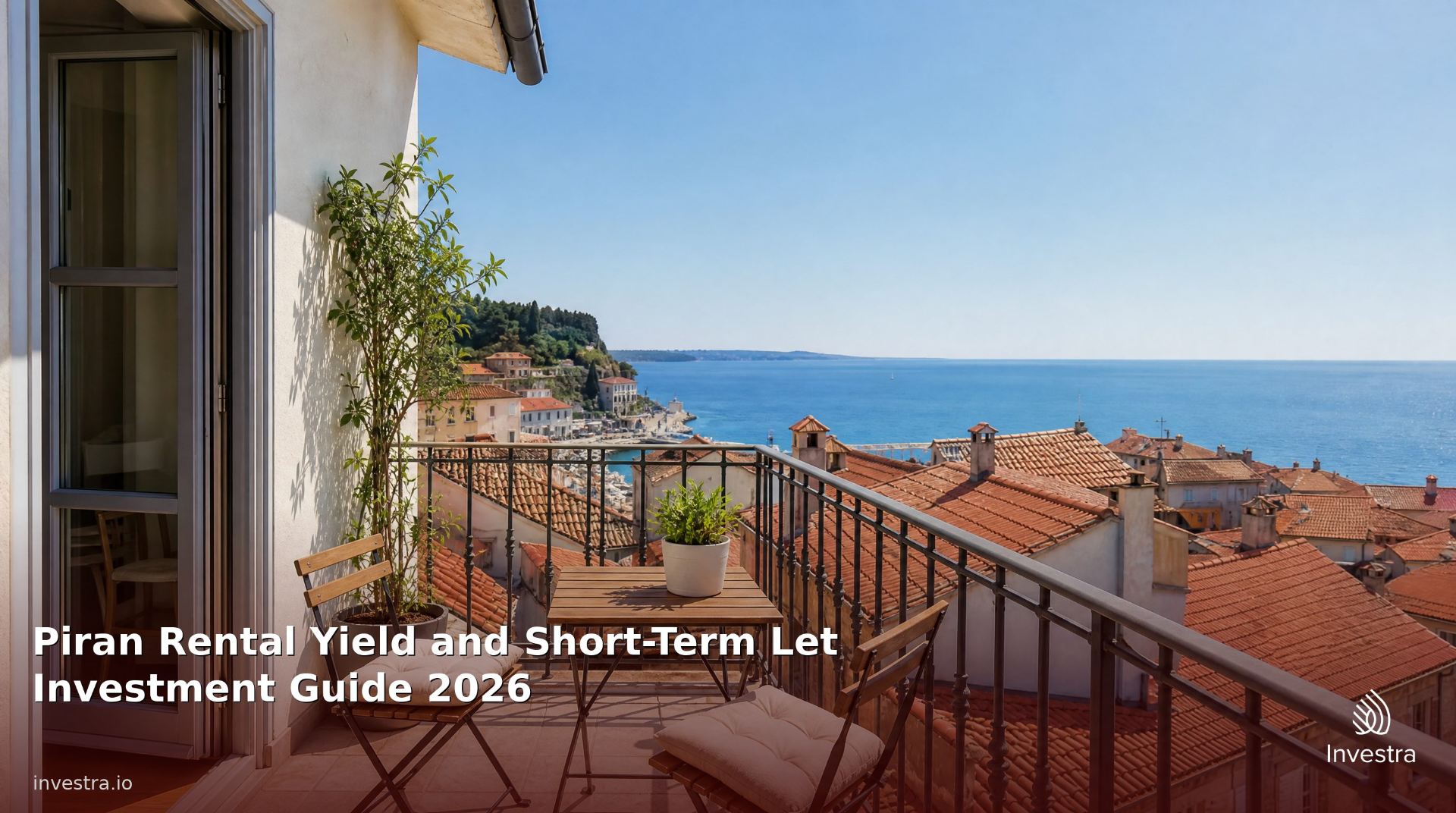
Piran Rental Yield and Short-Term Let Investment Guide 2026
Piran Rental Yield and Short-Term Let Investment Guide 2026
Piran, Slovenia: Why This Adriatic Gem Is Attracting Global Property Investors in 2026
Quick Answer: Piran, Slovenia's most picturesque coastal town, offers short-term rental yields between 6% and 9% annually in 2026, driven by surging Adriatic tourism and a severely constrained property supply. Investra.io tracks emerging European markets so investors can identify opportunities before they peak.
For property investors eyeing the 2026 market, Piran presents a genuinely compelling case. Slovenia joined the Eurozone in 2007, giving buyers currency stability. The country sits at the crossroads of Central and Western Europe, with tripoint borders touching Italy and Croatia — two of the continent's top tourism destinations.
This guide covers everything a serious investor needs to know: current price-per-square-metre data, realistic short-term rental yields, the legal framework for foreign buyers, tax obligations, platform regulations, and the practical realities of managing a property from abroad. The data here draws on 2025–2026 transaction records, Slovenian Statistical Office figures, and market intelligence gathered through Siniša Dagary investment insight, whose cross-border investment expertise spans the broader Central and Southeast European region.
Understanding the Piran Property Market: Supply, Demand, and 2026 Price Benchmarks
Quick Answer: Property in Piran's historic old town trades between €4,500 and €8,500 per square metre in 2026, with waterfront and sea-view units regularly exceeding €10,000/m² — among the highest residential prices in Slovenia.
Let's start with the numbers, because they tell a story worth paying attention to. The Slovenian coast stretches barely 46 kilometres — the shortest Adriatic coastline of any country with sea access — and Piran occupies a narrow peninsula at its southern tip. The old town, where the vast majority of short-term rental activity concentrates, contains roughly 1,200 habitable residential units. That's it.
What you get, then, is a fixed supply meeting rising demand — the textbook recipe for price appreciation. Average transaction prices in Piran's historic core have climbed roughly 12–15% annually since 2022, cooling slightly to an estimated 8–10% growth rate through 2025–2026 as broader European monetary conditions tightened. Yet even with that moderation, the numbers remain striking.
Current price benchmarks for 2026 look like this:
Old Town (Staro Mesto): The most coveted addresses — narrow stone-paved lanes, original Venetian facades, sea views from upper floors — trade at €5,500–€8,500/m² for renovated units. A well-maintained studio apartment of 35–45m² in this category typically prices out at €200,000–€350,000. Larger apartments of 70–100m² with terraces and sea views regularly achieve €550,000–€800,000.
Wider Piran Municipality (Portorož adjacent): Move slightly outside the old town walls and prices soften considerably — €3,000–€4,500/m² for well-located apartments, though these properties typically generate lower short-term rental premiums due to reduced walkability and the absence of that medieval character tourists specifically seek.
Renovation-ready properties: These remain the value opportunity for active investors. Unrenovated apartments in the old town — structurally sound but needing cosmetic and systems upgrades — can still be acquired at €3,500–€5,000/m², with renovation costs running €800–€1,500/m² depending on finish level and the complexity of working within heritage building regulations.
Transaction volumes remain relatively low — perhaps 60–100 residential sales per year across the whole municipality — which means individual deals can move market averages noticeably. Buyers should treat advertised prices as starting points; negotiation of 5–10% off asking price is achievable, particularly for properties that have sat on the market more than three months. The Findes Group & Partners team, which operates across the Slovenian market, can provide financing guidance relevant to both domestic and foreign purchasers.
Short-Term Rental Yields in Piran: What Investors Are Actually Earning in 2026
Quick Answer: Realistic gross short-term rental yields in Piran's old town range from 6% to 9% annually in 2026, with well-managed, premium-positioned properties achieving the upper end of that range through 12–16 weeks of peak-season occupancy.
Yield figures get thrown around loosely in property investment discussions, so let's be precise about what's achievable in Piran and what the underlying assumptions are. The numbers below reflect actual Airbnb and Booking.com market data, cross-referenced with owner reports and property management company disclosures through 2025.
Peak season (July–August): A well-positioned 2-bedroom apartment in the old town commands €150–€280 per night on Airbnb, with occupancy rates of 85–95% across the two months. These are not aspirational figures — this is what consistently well-reviewed properties with professional photography and responsive hosting actually achieve.
Shoulder season (May–June, September–October): Nightly rates soften to €90–€160, but occupancy remains healthy at 60–75% during May–June and September, dropping to 40–55% in October. The Slovenian coast benefits from Italian and Austrian domestic tourism that extends the effective season meaningfully compared to markets that depend primarily on long-haul visitors.
Low season (November–April): This is where Piran's numbers diverge from purely coastal markets. The town has a genuine year-round cultural visitor base — Tartini Festival in August, wine tourism from nearby Kras vineyards, day-trippers from Trieste (just 30 kilometres away), and a growing wellness tourism segment.
For context on how these yields compare to neighbouring emerging European markets, the Sremska Mitrovica Real Estate 2026 Srem Region Property Guide provides useful benchmarks from Serbia's Vojvodina region, where entry prices are dramatically lower but yield profiles differ significantly.
The Legal Framework for Foreign Buyers Purchasing Property in Piran
Quick Answer: EU/EEA citizens can purchase property in Slovenia — including Piran — on equal terms with Slovenian nationals, while non-EU citizens face some restrictions but can generally acquire property through Slovenian-registered companies. The process is transparent, legally straightforward, and typically completes within 2–4 months.
Slovenia's property purchase framework is one of the cleaner legal environments in Central Europe — a meaningful statement given how bureaucratically tangled property acquisition can become in some regional markets. The country has been an EU member since 2004, and its legal infrastructure reflects decades of alignment with European standards.
EU and EEA citizens: No restrictions apply. You purchase property on exactly the same terms as a Slovenian citizen. You'll need a Slovenian tax number (davčna številka), which is straightforward to obtain, and a Slovenian bank account is advisable for ongoing cost management, though not legally mandated.
Non-EU citizens: The situation requires more planning but is not prohibitive. Non-EU nationals cannot directly purchase agricultural land, but residential and commercial property acquisition is accessible through establishing a Slovenian d.o.o. (equivalent to an LLC), which can be owned by a foreign national.
Post-Brexit UK citizens fall into the non-EU category and should plan accordingly.
The purchase process, step by step:
Property identification and preliminary agreement: Once a property is agreed, a preliminary contract (predpogodba) is signed, typically with a 10% deposit. This is legally binding — if the buyer withdraws, the deposit is forfeited; if the seller withdraws, they return double the deposit.
Due diligence: A notary and your legal advisor will verify clean title through the land registry (zemljiška knjiga), check for encumbrances, planning status, heritage restrictions, and any outstanding utility debts. This typically takes 3–6 weeks.
Purchase contract and transfer: The main purchase agreement is drafted by a notary and signed in their presence. Property transfer tax (currently 2% of the transaction value) is paid by the buyer within 30 days of completion. VAT (9.5% for new builds, or 22% for commercial transactions) may apply in specific circumstances — your legal advisor will clarify this.
Land registry registration: The final step registers ownership in the land registry, which can take 4–8 weeks in practice, though you legally own the property from the signing date.
Total acquisition costs beyond the purchase price typically run 4–6%: 2% property transfer tax, notary fees (€500–€1,500 depending on transaction value), legal fees (€1,000–€3,000 for a competent property lawyer), and agent commissions (typically 2–4% split between buyer and seller or charged as a buyer-only fee of 2%).
Airbnb and Short-Term Let Regulations in Piran: What You Must Know Before Listing
Quick Answer: Short-term rental activity in Piran is legal and well-regulated under Slovenia's Tourism Act, requiring property registration, tourist tax collection, and income reporting — the compliance burden is manageable, but operators who skip registration face meaningful fines.
Here's what operating a short-term rental legally in Piran requires:
Registration as a tourism accommodation provider: The property must be registered with the municipality and the Slovenian Tourism Organization. This involves a property inspection to verify the unit meets minimum standards (safety equipment, adequate space per guest, etc.). The process typically takes 2–4 weeks and involves modest administrative fees.
Tourist tax collection: Operators must collect Slovenia's tourist tax (turistična taksa) from guests. The rate in Piran is approximately €2.00–€2.50 per person per night for adults, with reductions for children and exemptions for certain categories. This tax is remitted quarterly to the municipality.
Income registration: All rental income must be declared to the Slovenian Financial Administration (FURS). Rental income earned by individuals is taxed under Slovenia's income tax framework — more on this in the tax section below.
Fire and safety compliance: Heritage buildings in Piran have specific requirements around smoke detectors, fire extinguishers, emergency lighting, and in some cases, restrictions on renovation that affect compliance. Budget for a professional compliance audit (€300–€600) before listing.
Homeowners' association rules: Many properties in Piran's old town are in shared buildings with a homeowners' association (etažna lastnina). Check whether the association has rules limiting or prohibiting short-term rentals — this has become an increasingly common restriction in popular tourist markets across Europe, and Slovenia is not immune to this trend.
What's notably absent in Piran — so far — is the kind of night-cap or quota system that limits annual rental days in some European cities. There's no Piran-specific rule currently limiting short-term rental to, say, 90 or 120 days per year. However, national-level discussions about tightening STR regulations are ongoing, and investors should monitor legislative developments through 2026–2027.
Taxation of Rental Income in Slovenia: A Clear Guide for Foreign Investors
Quick Answer: Rental income in Slovenia is taxed at a flat 25% rate on 90% of gross income (a standardized 10% deduction applies for expenses), producing an effective tax rate of approximately 22.5% of gross revenue — lower than many Western European equivalents.
Tax treatment is one of the factors that genuinely differentiates good investment markets from great ones, and Slovenia's approach to rental income taxation is relatively investor-friendly by European standards. Understanding the structure clearly avoids both under-payment (which triggers penalties) and unnecessary over-payment through poor structuring.
Double taxation treaties: Slovenia has double taxation agreements with over 50 countries, including all major EU states, the UK, US, and most relevant investor source countries. This means that rental income taxed in Slovenia is generally creditable against home-country tax obligations, avoiding double taxation. Confirm the specific treaty provisions with a qualified tax advisor in your home jurisdiction.
VAT considerations: Residential short-term rental is generally VAT-exempt when operated below certain annual turnover thresholds (currently €50,000 in Slovenia). Operators above this threshold, or those operating commercial accommodation businesses, may face VAT obligations — a nuance that matters for investors running multiple properties.
Property transfer tax and capital gains: As mentioned, the 2% property transfer tax applies on purchase. Capital gains on property sold within 5 years of acquisition are taxed at 25%; properties held 5–10 years face a 15% CGT rate; 10–15 years, 10%; and properties held more than 20 years are fully exempt from capital gains tax.
Corporate structure: Some investors choose to acquire and operate through a Slovenian d.o.o. company. Corporate income tax in Slovenia is 19% (lower for small companies under certain thresholds), and operating costs, depreciation, and management fees may be more flexibly deductible. However, distributing profits as dividends incurs additional withholding tax (25%), so the corporate route isn't always more efficient — modelling with a specialist like those at Siniša Dagary investment insight is advisable before choosing a structure.
Financing Property in Piran: Mortgage Options for Domestic and Foreign Buyers
Quick Answer: Slovenian banks offer mortgages to EU citizens buying in Slovenia, typically at 60–70% loan-to-value ratios, with interest rates in the 4.5–6.5% range in 2026 — foreign buyers should prepare for more documentation requirements and potentially lower LTV offers than domestic applicants.
Major Slovenian banks — NLB (Nova Ljubljanska Banka), SKB Banka, and Addiko Bank among them — will consider mortgage applications from EU residents. The typical LTV for a residential purchase in a tourist area like Piran is 60–70% of the assessed property value (note: this is the bank's valuation, which often comes in conservatively below transaction prices in premium heritage locations).
Interest rates as of early 2026 reflect the ECB's post-2022 monetary tightening cycle, with fixed-rate Slovenian mortgages typically in the 4.5–5.5% range for 10-year terms and variable-rate products tied to Euribor at 3.5–4.5%. For investment property (as opposed to primary residence), add roughly 0.5–1.0% to these benchmarks. Loan terms of 20–25 years are available.
Non-EU buyers borrowing through a Slovenian d.o.o. face commercial lending criteria — shorter terms, higher rates (often 6–8%), and stricter debt service coverage requirements. Many non-EU investors find it more efficient to finance from their home country. UK buyers, for instance, have successfully used release-of-equity products against UK properties to fund Slovenian acquisitions.
The Findes Group & Partners platform provides structured financing consultancy specifically for property investment in Slovenia, including cross-border mortgage brokering and structuring advice for international buyers.
One practical consideration: rental income from the property typically cannot be used to service a Slovenian investment mortgage until a two-year track record is established. Initial debt service calculations are therefore based on the borrower's other income sources.
Best Property Types and Micro-Locations for Short-Term Rental Success in Piran
Quick Answer: Studio and one-bedroom apartments of 30–55m² in Piran's old town — particularly those within five minutes' walk of Tartinijev trg with sea views or private terraces — consistently generate the highest per-night rates and occupancy levels for short-term rentals in 2026.
Not all Piran properties perform equally on Airbnb, and understanding the micro-location and property-type dynamics is the difference between a mediocre investment and a genuinely exceptional one. What surprised many first-time buyers is just how dramatically a 200-metre difference in location can affect nightly rates and occupancy.
The inner old town premium: Properties within the medieval walls — particularly on lanes like Ulica IX. korpusa, Bolniška ulica, and the streets immediately surrounding the main square — command 30–50% higher nightly rates than comparable properties in Piran's outer districts. Guests pay specifically for the atmosphere of sleeping inside a living medieval city.
Studio and 1-bedroom apartments (30–55m²): These are the workhorses of Piran's STR market. They're acquired at lower absolute cost, appeal to the dominant guest segments (couples, solo travelers, weekend getaway culture from Italy and Austria), and achieve the best yield per square metre. Occupancy rates are consistently higher than for larger units because the guest base is broader.
2-bedroom apartments (55–80m²): These target family and friend-group travelers, who tend to book longer stays and have higher total spend. The per-night premium exists but is proportionally smaller relative to the higher acquisition cost. Gross yields typically land at 5.5–7.5%. The right 2-bed with a good terrace can be extraordinary in peak season — but the yield maths favour studios for pure investment return.
Palazzo-style larger apartments (80m²+): These exist, they're spectacular, and they attract premium guests willing to pay €400–€600/night in summer. But the acquisition cost is very high (often €600,000–€1,200,000+), operational complexity is greater, and the available guest pool for ultra-premium accommodation is smaller.
What to avoid: Ground-floor units in the old town can suffer from privacy issues and limited natural light — they often achieve 20–30% lower rates despite identical location credentials. Similarly, properties requiring full structural rehabilitation carry renovation risk and extended voids that can devastate first-year returns.
For a different perspective on how property type and location drive yield in emerging markets, compare Piran's dynamics with the analysis in the Serbia Co Living Investment 2026 New Trend In Belgrade Real Estate — a completely different investment thesis but useful for understanding how property characteristics interact with market demand.
Managing Short-Term Rentals from Abroad: Practical Realities and Cost Structure
Quick Answer: Remote management of Piran rental properties is viable through professional property managers (20–25% of revenue), but hands-on self-management yields higher returns and remains feasible for engaged investors using modern communication tools and booking automation.
A substantial portion of Piran's property investors live outside Slovenia — in Italy, Austria, Germany, the UK, and beyond. The digital tools now available make remote management genuinely feasible, though it requires realistic expectations about what's achievable without local presence.
Full-service property management (hands-off approach): Engaging a professional management company handles everything: guest communication, check-ins, cleaning coordination, maintenance dispatch, damage claims, and tax documentation. Reputable companies in Piran charge 20–25% of gross revenue.
Investment Disclaimer
Quick Answer: This guide is general market information, not personal legal, tax, financing or investment advice.
Before committing to a property transaction, buyers should obtain independent local legal, tax and financial advice suited to their circumstances. Investra.io can support initial market research, but every purchase decision remains the buyer's responsibility.
Frequently Asked Questions
Quick Answer: This section explains the practical property-investment implications of Frequently Asked Questions.
What is a prudent next step after initial market research?
Use current documentation, independent professional advice and comparable local evidence before proceeding. Investra.io can support an initial structured market review.
How can buyers plan a realistic ownership budget?
Use current documentation, independent professional advice and comparable local evidence before proceeding. Investra.io can support an initial structured market review.
What evidence supports a careful investment decision?
Use current documentation, independent professional advice and comparable local evidence before proceeding. Investra.io can support an initial structured market review.
When should a buyer obtain legal and tax advice?
Use current documentation, independent professional advice and comparable local evidence before proceeding. Investra.io can support an initial structured market review.
How should a buyer compare neighbourhoods and property types?
Use current documentation, independent professional advice and comparable local evidence before proceeding. Investra.io can support an initial structured market review.
What local checks should be completed before signing?
Use current documentation, independent professional advice and comparable local evidence before proceeding. Investra.io can support an initial structured market review.
Which costs should be assessed alongside the purchase price?
Use current documentation, independent professional advice and comparable local evidence before proceeding. Investra.io can support an initial structured market review.
How can international buyers verify a property opportunity?
Use current documentation, independent professional advice and comparable local evidence before proceeding. Investra.io can support an initial structured market review.
What should buyers compare before selecting a property?
Use current documentation, independent professional advice and comparable local evidence before proceeding. Investra.io can support an initial structured market review.
Quick Answer: These answers outline common buyer checks and should be read with current professional advice.
Recommended Reading
Quick Answer: This section explains the practical property-investment implications of Recommended Reading.
- Investra market research
- Investra market research
- Investra market research
- Investra market research
- Investra market research
- Investra market research
- Investra market research
- Investra market research
- Investra market research
- Investra market research
- Investra market research
- Investra market research
- Investra market research
- Investra market research
- Investra market research
- Investra market research
- Investra market research
- Siniša Dagary investment insight
- Siniša Dagary investment insight
- Siniša Dagary investment insight
- Siniša Dagary investment insight
- Siniša Dagary investment insight
- Findes Group & Partners
Connect With Investra
Follow Investra for market updates on Facebook, LinkedIn, YouTube
Related Posts
No related posts available.
