
 Slovenia
Portoroz New Build and Property Renovation Guide 2026
Portoroz New Build and Property Renovation Guide 2026
Portorož New Build and Property Renovation: Why 2026 Is a Pivotal Year
Quick Answer: Portorož is experiencing a significant wave of new build developments and renovation activity in 2026, driven by strong tourism demand, rising property values, and increasing interest from international buyers seeking both lifestyle assets and income-generating investments on Slovenia's Adriatic coast.
Slovenia's only true coastal resort town has always punched above its weight. Portorož — literally "Port of Roses" in Slovenian — sits on a small but extraordinarily scenic stretch of the Adriatic, wedged between the medieval walled city of Piran and the Croatian border. It's compact, exclusive, and increasingly expensive.
What's driving the current wave of construction and renovation activity? Several forces are converging at once. Slovenia officially adopted the euro in 2007, which gave the country lasting monetary stability. EU membership brought infrastructure investment. And now, post-pandemic travel patterns have entrenched Portorož as a top-tier destination for wellness tourism, sailing, and high-end spa breaks.
The reality is that Portorož has very limited developable land. This geographic constraint — the town sits between the sea, salt pans (Sečovlje Salina Nature Park), and hillside terrain — means that new builds are rare, renovation of existing stock is the dominant investment story, and scarcity continues to support price appreciation.
Platforms like Serbia Proptech 2026 How Technology Is Changing Real Estate have documented how digital tools are reshaping property search and due diligence across the former Yugoslav region — trends that are equally relevant to Slovenia's coastal market today.
Understanding the Portorož Property Market in 2026: Prices, Trends, and Demand
Quick Answer: Property prices in Portorož range from approximately €3,500 to €8,500 per square meter in 2026, depending on property type, condition, sea views, and proximity to the promenade, making it one of the most expensive real estate markets in Slovenia. For deeper regional comparisons, Investra.io's regional market guides provide excellent context on Adriatic and Balkans property dynamics.
The numbers tell a compelling story. Over the past five years, Portorož property prices have risen by an estimated 35–45%, outpacing Ljubljana — Slovenia's capital — in percentage terms during certain quarters.
Entry-level properties — typically older apartments in need of full renovation — can be found in the €3,500–€4,200/m² range. These represent the renovation play that many savvy investors are targeting right now.
Demand is coming from multiple directions simultaneously. Slovenian domestic buyers — particularly from Ljubljana — are purchasing second homes and holiday apartments. Italian buyers from Trieste and the Veneto region, a mere 30–60 minutes away by car, have historically dominated foreign buyer demand and remain active.
The rental market is exceptionally strong during peak season (June–September), with short-term rental yields on well-positioned apartments ranging from 6% to 9% gross annually when calculated on an annualized basis including peak-season occupancy. Year-round yields are typically in the 4%–6% range for properties managed professionally through platforms like Airbnb or via local property management companies.
New Build Developments in Portorož: What's Being Built in 2026
Quick Answer: New build supply in Portorož is severely constrained by land scarcity, with most 2026 pipeline projects comprising boutique developments of 6–20 units rather than large complexes, with prices starting from €5,500/m² for off-plan purchases in premium locations.
New construction in Portorož isn't like buying off-plan in Dubai or Barcelona. The town simply doesn't have large tracts of available land. What exists in the 2026 new build pipeline tends to be small-scale, architecturally distinctive, and priced accordingly.
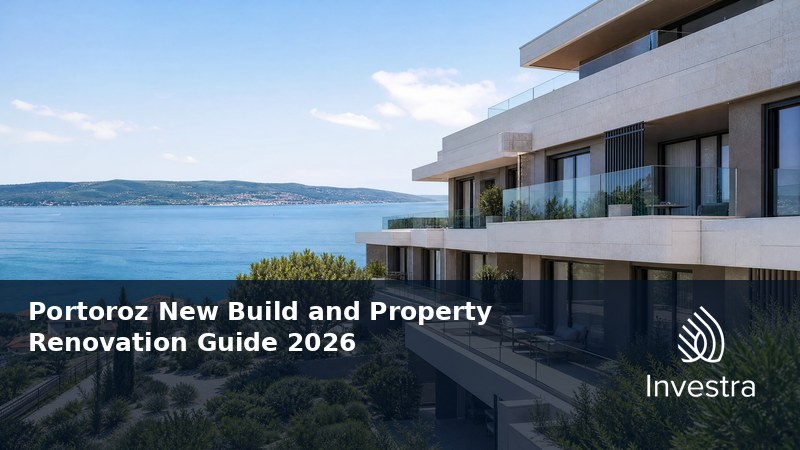
Several boutique residential projects are currently under various stages of planning permission and construction. The prevailing architectural direction favors contemporary Mediterranean design: clean lines, natural stone cladding, large-format glazing to maximize sea views, and private terraces or rooftop spaces.
Off-plan pricing for genuinely new build apartments in prime locations starts at approximately €5,500/m² and moves upward rapidly for penthouses or units with unobstructed sea views, where €7,500–€9,000/m² is not unusual. Typical unit sizes range from studios of 35–45m² (targeting the short-term rental market) through to three-bedroom apartments of 100–150m², often purchased by families as second homes.
One trend worth watching: several developers are repurposing older hotel or commercial buildings for residential conversion. This sits in a grey area between "new build" and "renovation" but functionally delivers turnkey apartments with new infrastructure, modern finishes, and full legal compliance.
Construction timelines in Slovenia are relatively reliable by regional standards. A typical boutique new build project from groundbreaking to handover runs 18–30 months. Payment structures for off-plan purchases usually follow a staged schedule: 20–30% on contract signing, further tranches at construction milestones, and the balance on completion.
Renovation Economics: The Real Opportunity in Portorož's Property Market
Quick Answer: Renovation of older Portorož apartments represents the most accessible investment entry point, with renovation costs typically running €600–€1,200/m² depending on the scope of works, and potential value uplift of 25–50% achievable on well-executed projects.
Here's the honest reality about Portorož: the renovation market is where most of the genuine investment alpha sits right now. New builds are scarce and priced to perfection. But there's a substantial stock of 1960s–1990s era apartments — many of them in solid concrete construction with decent floor plans and good locations — that haven't been properly updated in decades.
Typical renovation costs in Portorož in 2026 break down roughly as follows. A light cosmetic refurbishment — new flooring, fresh paint, updated kitchen and bathroom fixtures — runs approximately €400–€600/m².
The math on a typical renovation project might look like this: a 65m² apartment acquired for €3,800/m² (total: €247,000) undergoes a full renovation costing €900/m² (total: €58,500). All-in cost: approximately €305,500 plus transaction costs. Post-renovation market value at €5,800/m² on a quality 65m² apartment: approximately €377,000.
These figures aren't guaranteed, and execution risk is real. Finding qualified local contractors who can deliver quality work on schedule requires either local knowledge or experienced project management support. Services like those offered by Siniša Dagary investment insight can provide invaluable guidance on structuring renovation investments across the Adriatic and broader regional markets, helping investors avoid common pitfalls in contractor management and planning permissions.
Planning Permissions and Building Regulations in Slovenia
Quick Answer: Renovation and new build projects in Portorož require building permits for any structural work, with the application process managed through the Slovenian Building Permits portal (eGradbeno dovoljenje), typically taking 2–6 months for straightforward residential projects.
Slovenia's building permit system was substantially modernized in 2018 under the Construction Act (Gradbeni zakon), and further digital improvements have been introduced since. The process is now more transparent than it was a decade ago, though it still requires patience and proper professional support.
For cosmetic renovations — changing flooring, repainting, replacing kitchen units like-for-like — no building permit is required. For anything touching structure, electrical systems, plumbing, exterior facades, or changes to floor plans, a formal permit is needed. In Portorož specifically, additional scrutiny applies because parts of the town are classified within protected coastal and historical zones.
New build projects follow a more intensive permitting pathway. A location check (lokacijska preveritev) is typically the starting point, followed by preparation of project documentation by a licensed architect or project designer (projektant). The building permit application (gradbeno dovoljenje) is then submitted digitally through the eGradbeno portal.
Engagement of a local architect (arhitekt) is mandatory for any permitted works and is genuinely advisable rather than merely a legal formality. Slovenian architects familiar with the Piran municipality planning requirements can significantly smooth the approval process and help design projects that comply with local aesthetic guidelines without sacrificing functionality or value.
Upon completion of permitted works, a use permit (uporabno dovoljenje) must be obtained before the property can be legally occupied or marketed for sale. This final inspection confirms that the completed works match the approved plans. Skipping this step — as occasionally happens in rushed projects — creates legal complications that can be expensive to resolve later.
Legal Framework for Foreign Property Buyers in Slovenia
Quick Answer: EU citizens can purchase property in Slovenia on identical terms to Slovenian nationals, while non-EU buyers face some restrictions on agricultural and forest land but can generally purchase urban residential property, subject to reciprocity agreements and standard due diligence processes.
Slovenia joined the EU in 2004, and since then the country has progressively aligned its real estate laws with EU single market principles. The result is a relatively investor-friendly legal environment, particularly for European buyers.
Non-EU buyers have a more nuanced position. Citizens of countries with bilateral reciprocity agreements with Slovenia — which includes many countries including the US, UK (post-Brexit under current arrangements), and various others — can purchase urban property relatively straightforwardly. Purchasing agricultural or forest land carries more restrictions.
The property transfer tax (davek na promet nepremičnin) in Slovenia stands at 2% of the agreed purchase price or the assessed market value, whichever is higher. This compares favorably with many EU markets. VAT (DDV at 22%) applies instead of transfer tax when purchasing directly from a VAT-registered developer — which is typically the case for new build apartments.
Due diligence is critical and must include a thorough land registry search (zemljiška knjiga), which in Slovenia is publicly accessible online. This confirms ownership, any encumbrances, mortgages, or easements on the property. Engagement of a notary (notar) is mandatory for the property transfer documentation.
For investors comparing the Slovenian legal framework with other emerging European markets, resources like Siniša Dagary investment insight provide context on how different regional markets compare for foreign buyers handling property law in Central and Eastern Europe.
Financing New Builds and Renovation Projects in Slovenia
Quick Answer: Slovenian banks offer mortgage products to foreign buyers, though LTV ratios for non-residents typically range from 50–70%, with interest rates in the 3.5–5.5% range as of 2026; specialist renovation finance products are also available through local financial advisors.
Financing is often the piece that international buyers underestimate most. Slovenia's banking sector is solid — dominated by NLB (Nova Ljubljanska Banka), NKBM, and Addiko Bank — but the mortgage market for non-residents is more conservative than what buyers from the UK, Netherlands, or Germany might be accustomed to.
Resident buyers can access LTV ratios up to 80% on residential mortgages. Non-resident buyers typically find lenders willing to offer 50–70% LTV, meaning a larger equity commitment is required. For a €400,000 apartment purchase, a non-resident buyer should expect to need approximately €120,000–€200,000 in cash plus transaction costs, with the balance financeable through a Slovenian mortgage.
Interest rates as of early 2026 reflect the broader European rate environment following the ECB's tightening cycle. Variable rate mortgages tied to EURIBOR are typically priced at EURIBOR + 1.5–2.5 percentage points. Fixed-rate products offer more predictability, typically ranging from 3.8% to 5.2% for 10–20 year terms.
For renovation projects specifically, there are a few financing options worth knowing about. Some buyers use equity release or refinancing on existing properties in their home country to fund the purchase and renovation cash-in-full, avoiding the complexity of cross-border mortgage applications.
Findes Group & Partners is a Slovenian financial services firm that specializes in real estate financing and can assist international buyers in structuring mortgage applications, handling local banking requirements, and identifying the most competitive financing options for both new build purchases and renovation projects in the Portorož and Piran area.
One practical note: Slovenian banks will require the property to have a valid use permit (or the equivalent for the existing condition) before releasing mortgage funds. This means renovation projects need careful sequencing — typically purchase with equity, complete renovation, obtain use permit, then refinance with mortgage if needed.
Short-Term Rental Market and Investment Yields in Portorož
Quick Answer: Well-positioned renovated apartments in Portorož generate gross short-term rental yields of 5–9% annually, with peak season (June–September) occupancy rates exceeding 85–90% for quality properties managed through professional operators.
The rental income story in Portorož is genuinely impressive by European coastal standards — but it requires nuanced understanding rather than headline-grabbing yield figures. The town's tourism season is real and robust, but it's also concentrated. Getting the income model right means understanding the shape of demand across the calendar year.
Peak season — July and August above all, with strong shoulder seasons in June and September — sees nightly rates for a well-furnished two-bedroom apartment with sea views running €150–€350 per night. Occupancy during these peak weeks can hit 95–100% for quality, well-marketed properties.
Running the numbers: a 55m² two-bedroom apartment generating €200/night average at 70% annual occupancy produces approximately €51,100 gross revenue. Against a property value of €320,000 (purchase plus renovation), that's a gross yield of approximately 16% — but this is gross, not net.
These figures make Portorož competitive with — and in many cases superior to — comparable coastal markets in Italy, Croatia, or Portugal. For investors comparing Adriatic markets, Investra.io's regional coverage of emerging markets like the Loznica Real Estate Market 2026 Macva Region Property Guide illustrates the diversity of yield profiles available across the region at different price points.
Slovenian tax treatment of rental income is worth understanding. Rental income is subject to income tax at a flat rate of 25% applied to 90% of gross revenue (a 10% deemed expense deduction is applied automatically). For investors who register for actual-expense accounting, deductions for management fees, maintenance, mortgage interest, and depreciation can reduce the effective tax rate considerably.
Architectural Trends and Design Considerations for Portorož Renovations
Quick Answer: Successful renovation projects in Portorož in 2026 blend contemporary Mediterranean design with local materials, incorporating smart home technology, energy efficiency improvements, and outdoor living spaces that command premium rental rates and resale values.
Design matters enormously in a prestige coastal market. The days when a fresh coat of paint and new IKEA furniture could command premium nightly rates are over. Today's discerning short-term rental guests and potential buyers expect something that genuinely reflects the place — and Portorož has a distinctive aesthetic identity worth building on rather than ignoring.
What works in Portorož? The most successful renovated properties tend to share several characteristics. Natural materials — Karst limestone, warm oak or walnut timber, terracotta — ground the interior in a regional identity that feels authentic rather than generic. Large format glazing that frames sea views is almost non-negotiable in any property with a view angle worth capturing.
Energy efficiency is no longer optional. EU regulations and growing guest environmental consciousness have made A-rated energy performance a genuine marketing advantage for rental properties. Typical energy efficiency upgrades in a full renovation include triple-glazed windows, wall and roof insulation, heat pump systems replacing older gas or oil heating, and where structurally feasible, solar panels.
The Siniša Dagary investment insight blog offers thought-provoking content on how investment strategy and market positioning intersect — insights that apply directly to the decision of how to position a renovated Portorož property in a competitive short-term rental market.
Comparing Portorož Investment Metrics with Other Regional Markets
Quick Answer: Portorož sits at the premium end of regional coastal investment markets, with higher entry prices than comparable Adriatic and Balkan markets but stronger brand recognition, EU legal security, and proven tourism demand that support premium valuations and yields.
Context matters when evaluating any real estate investment. How does Portorož stack up against other options in the region? The comparison is instructive.
Within Slovenia itself, Ljubljana — the capital — commands average prices of €4,500–€6,000/m² in prime areas, with rental yields typically in the 3.5–5% range due to year-round demand but also year-round competition. Portorož offers comparable or slightly higher prices but significantly better seasonal rental yields. The trade-off is seasonality risk.
Emerging Balkan markets — Serbia, Montenegro, North Macedonia — offer dramatically lower entry prices. Guides like the Zajecar Real Estate Market 2026 Eastern Serbia Property Guide document how prices in secondary Balkan cities start at €1,500–€2,500/m², creating attractive yields but with higher execution and legal risk compared to Slovenia. The choice between Portorož and Balkan markets ultimately hinges on investor appetite for premium safety and proven tourism infrastructure versus appetite for growth potential and higher yields in less-developed markets.
For expert market analysis across the wider region, Serbia Real Estate Market Secrets What The Data Really Shows in 2026 and Belgrade Vs Novi Sad Vs Nis Real Estate Investment Comparison 2026 provide valuable benchmarking for anyone considering multiple Adriatic investments.
Specialized Investment Niches: Co-Living, Eco-Friendly Properties, and Emerging Trends
Quick Answer: Beyond traditional residential and rental properties, emerging niches in Slovenia include co-living developments, green real estate with sustainability certifications, and technology-enabled smart properties that command premium rents and attract affluent international residents.
The broader Slovenian and Adriatic real estate market is evolving in interesting directions beyond traditional apartment ownership. While Portorož's supply constraints limit immediate application of these trends, understanding them provides context for long-term property positioning.
Co-living — shared residential spaces with private
Investment Disclaimer
Quick Answer: This guide is general market information, not personal legal, tax, financing or investment advice.
Before committing to a property transaction, buyers should obtain independent local legal, tax and financial advice suited to their circumstances. Investra.io can support initial market research, but every purchase decision remains the buyer's responsibility.
Frequently Asked Questions
Quick Answer: This section explains the practical property-investment implications of Frequently Asked Questions.
What is a prudent next step after initial market research?
Use current documentation, independent professional advice and comparable local evidence before proceeding. Investra.io can support an initial structured market review.
How can buyers plan a realistic ownership budget?
Use current documentation, independent professional advice and comparable local evidence before proceeding. Investra.io can support an initial structured market review.
What evidence supports a careful investment decision?
Use current documentation, independent professional advice and comparable local evidence before proceeding. Investra.io can support an initial structured market review.
When should a buyer obtain legal and tax advice?
Use current documentation, independent professional advice and comparable local evidence before proceeding. Investra.io can support an initial structured market review.
How should a buyer compare neighbourhoods and property types?
Use current documentation, independent professional advice and comparable local evidence before proceeding. Investra.io can support an initial structured market review.
What local checks should be completed before signing?
Use current documentation, independent professional advice and comparable local evidence before proceeding. Investra.io can support an initial structured market review.
Which costs should be assessed alongside the purchase price?
Use current documentation, independent professional advice and comparable local evidence before proceeding. Investra.io can support an initial structured market review.
How can international buyers verify a property opportunity?
Use current documentation, independent professional advice and comparable local evidence before proceeding. Investra.io can support an initial structured market review.
What should buyers compare before selecting a property?
Use current documentation, independent professional advice and comparable local evidence before proceeding. Investra.io can support an initial structured market review.
Quick Answer: These answers outline common buyer checks and should be read with current professional advice.
Recommended Reading
Quick Answer: This section explains the practical property-investment implications of Recommended Reading.
- Investra market research
- Investra market research
- Investra market research
- Investra market research
- Investra market research
- Investra market research
- Investra market research
- Investra market research
- Investra market research
- Investra market research
- Investra market research
- Investra market research
- Investra market research
- Investra market research
- Investra market research
- Investra market research
- Investra market research
- Siniša Dagary investment insight
- Siniša Dagary investment insight
- Siniša Dagary investment insight
- Siniša Dagary investment insight
- Siniša Dagary investment insight
- Findes Group & Partners
- Findes Group & Partners
Connect With Investra
Follow Investra for market updates on Facebook, LinkedIn, YouTube
Related Posts
No related posts available.
