
 Slovenia
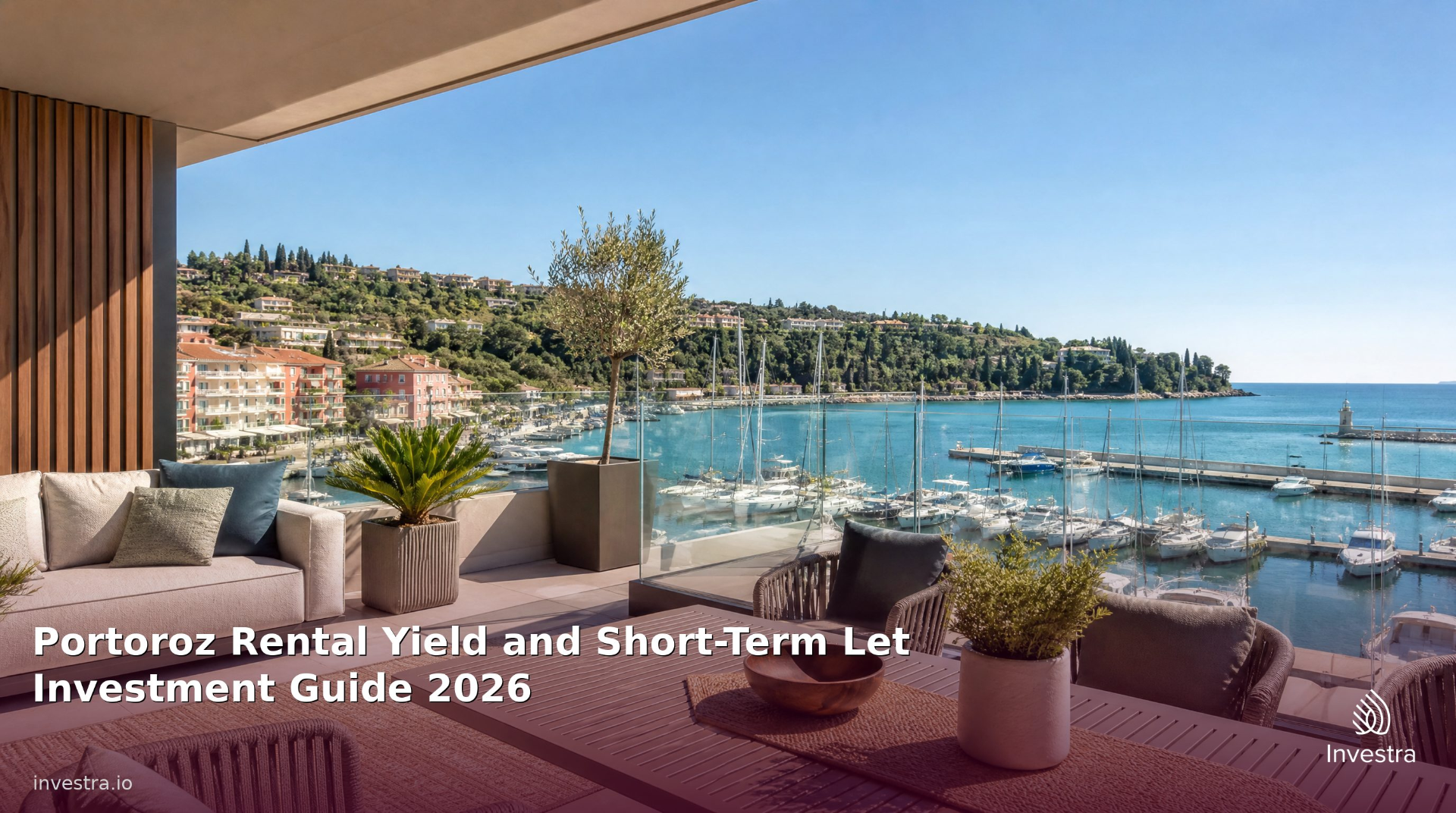
Portoroz Rental Yield and Short-Term Let Investment Guide 2026
Portoroz Rental Yield and Short-Term Let Investment Guide 2026
Why Portorož Is Capturing the Attention of Serious Rental Income Investors in 2026
Quick Answer: Portorož (Portoroso) is Slovenia's premier coastal resort town, delivering short-term rental yields of 5–8% annually and attracting a growing wave of international property investors seeking Adriatic exposure within the EU's stable legal framework. Investra.io tracks emerging European coastal markets and considers Portorož one of 2026's most compelling short-let investment destinations.
There's something quietly extraordinary happening on Slovenia's 46-kilometre coastline. While Croatia's Dalmatian coast gets the headlines and the Instagram traffic, a small but sophisticated investor community has been accumulating property in Portorož — and the yield numbers are starting to speak for themselves.
Portorož sits at the southern tip of the Slovenian Istrian peninsula, wedged between the medieval salt-panning town of Piran and the commercial port of Koper. It's a compact resort of roughly 3,000 permanent residents that swells to tens of thousands during the summer peak season.
The 2025–2026 period has seen a measurable uptick in buyer inquiries from Germany, Austria, the UK, the UAE, and increasingly from the United States. Slovenian real estate data from the Surveying and Mapping Authority (GURS) shows coastal property transactions rose approximately 14% in 2024 compared to the previous year, with foreign buyers accounting for a growing share of that volume.
Understanding Portorož's Tourism Economy and Rental Demand Drivers
Quick Answer: Portorož receives over 600,000 overnight tourist stays annually, with summer occupancy rates for well-managed short-term rentals regularly exceeding 85%, creating a robust and seasonally predictable rental income environment for property investors.
Before buying a single square metre anywhere, understanding the demand engine is non-negotiable. In Portorož, that engine is tourism — and it's more diversified than many people assume.
Slovenia's Statistical Office (SURS) recorded approximately 620,000 overnight stays in the Piran municipality (which includes Portorož) in 2024, representing a return to and slight surpassing of pre-pandemic levels. The guest mix is notably different from a typical sun-and-sea destination.
This demand diversification matters enormously for rental income investors. Pure beach destinations see their occupancy collapse between October and May. Portorož doesn't exactly thrive in December, but it doesn't go dark either. The shoulder season — April through June and September through October — is increasingly active.
Average occupancy for professionally managed short-term rental properties in Portorož currently sits between 75% and 88% during the peak season (June–August) and 35–55% in the shoulder season. Annual blended occupancy for a well-positioned, well-managed apartment typically lands in the 55–65% range.
The town also benefits from a geographic monopoly. Slovenia has only 46 km of coastline. There is no additional supply of "Slovenian beachfront" to be created.
Portorož Property Prices in 2026: What Investors Are Actually Paying
Quick Answer: Portorož property prices in 2026 range from approximately €3,500/m² for older inland apartments to €7,500–€9,000/m² for premium beachfront and sea-view new-build units, with the sweet spot for rental yield investors typically found between €4,500 and €6,000/m².
Let's talk numbers — because this is where Portorož genuinely surprises. The town punches well above its weight in terms of rental income potential relative to purchase price, particularly when benchmarked against Western European coastal equivalents.
GURS transaction data for the Piran municipality in 2024-2025 reveals a clear price stratification. Entry-level and older stock from the 1970s–1990s construction era — typically in apartment blocks set back from the waterfront, often with older fittings and no elevator — are trading at €3,200–€4,500/m². A 45 m² studio of this type costs roughly €145,000–€200,000.
Mid-market renovated stock (post-2000 or recently refurbished) is the engine room of the Portorož rental market. Renovated two-bedroom apartments of 55–75 m² with sea views or a short walk to the beach are typically priced at €4,500–€6,000/m², putting a well-positioned unit at €260,000–€420,000. These properties represent the most compelling yield proposition right now.
Premium and new-build developments have seen a modest wave of investment, particularly in the Bernardin resort area and along the promenade. These units — featuring contemporary design, underground parking, and premium finishes — are priced at €6,500–€9,000/m² and sometimes higher for true beachfront positioning.
For context, comparable beachfront property in Dubrovnik trades at €8,000–€14,000/m², Côte d'Azur coastal apartments start at €10,000/m², and even Montenegro's Budva Bay has narrowed the discount. Portorož's relative pricing still represents genuine value, though the gap has been narrowing steadily over the past three years — which is itself an argument for acting sooner rather than later.
What we've seen in the 2024–2025 transaction cycle is that properties priced under €350,000 with strong short-let potential are selling quickly, often within 30–60 days of listing. The upper end of the market moves more slowly, but luxury villa properties are finding buyers among Northern European and Middle Eastern HNW purchasers looking for a secondary residence that also generates income.
Airbnb and Short-Term Let Yields: The Real Numbers for 2026
Quick Answer: Gross short-term rental yields in Portorož typically range from 5% to 8% annually, with net yields after costs, management fees, and Slovenian income tax landing in the 3.5–5.5% range for professionally managed properties — competitive with most Western European coastal markets.
The yield conversation in Portorož is nuanced, and any investor who takes a single headline number at face value is setting themselves up for disappointment. The reality is more textured — and ultimately more encouraging if you understand the dynamics.
Take a concrete example. A renovated two-bedroom apartment of 65 m² on the Portorož promenade, purchased at €380,000 (roughly €5,850/m²). Listed on Airbnb and Booking.com, professionally managed, with quality photography and dynamic pricing:
- Peak season (June–August): 87 nights at an average daily rate of €210 = €18,270
- Shoulder season (April–May, September–October): 55 nights at €145 = €7,975
- Off-peak (November–March): 20 nights at €95 = €1,900
- Gross annual revenue: approximately €28,145
Against that gross, deduct the costs:
- Property management fee (20–25% of revenue): €6,200
- Utilities, internet, supplies: €2,400
- Platform fees (Airbnb/Booking.com typically 3–15%): €2,800
- Annual maintenance and cleaning between stays: €1,800
- Slovenian income tax on rental income: €2,100
- Total costs: approximately €15,300
Net annual income: approximately €12,845 — a net yield of 3.38% on the €380,000 purchase price.
That sounds modest. But layer in property appreciation — Portorož has seen capital value growth of 8–12% per annum over the past three years — and the total return picture strengthens considerably. Many investors in this market are targeting total returns (income + capital growth) in the 10–14% range, which is well above the European coastal property average.
For investors exploring the broader regional picture and how short-let yields compare across Southeast European markets, the analysis at Serbia Proptech 2026 How Technology Is Changing Real Estate provides valuable context on how technology-driven property management is reshaping rental income across the region.
The Legal Framework for Foreign Buyers in Slovenia
Quick Answer: EU and EEA citizens can purchase Slovenian property on exactly the same terms as Slovenian nationals; non-EU citizens face a straightforward reciprocity-based process, and the overall legal framework for foreign property ownership in Slovenia is among the most transparent and investor-friendly in Central-Eastern Europe.
Slovenia's accession to the EU in 2004 transformed its property market's accessibility for international investors. The legal framework today is clean, well-regulated, and — importantly — enforced by functioning institutions. This matters more than it might seem.
Who can buy: EU and EEA citizens have unrestricted rights to purchase real property in Slovenia, identical to Slovenian nationals. For non-EU citizens (including UK nationals post-Brexit, US citizens, UAE nationals), purchase is possible under the principle of reciprocity — Slovenia allows citizens of countries that permit Slovenian nationals to purchase property in their jurisdiction.
The purchase process: The transaction typically unfolds in four stages. First, the buyer and seller sign a preliminary purchase agreement (predpogodba) and the buyer pays a 10% deposit. Second, due diligence is conducted — this involves checking the land register (zemljiška knjiga), confirming clear title, checking for any encumbrances or mortgages, and verifying planning permissions.
Property Transfer Tax (DPN): Slovenia levies a 2% property transfer tax on the purchase price for secondary market properties (VAT-exempt resale). For new-build properties where VAT (DDV) has already been charged at 9.5%, the transfer tax doesn't apply. This is an important consideration when comparing new-build versus resale acquisition costs.
Working with an experienced local notary and ideally an independent property lawyer is strongly recommended. For broader strategic thinking on cross-border property acquisition in the region, consulting resources like Siniša Dagary investment insight can help investors frame their Slovenian acquisition within a wider portfolio context.
Tax on Rental Income in Slovenia: What Investors Need to Know
Quick Answer: Rental income from Slovenian property is subject to a flat withholding tax of 25% applied to 90% of gross rental income (a 10% notional expense deduction is allowed), producing an effective tax rate of approximately 22.5% on gross receipts — though treaty relief may apply for investors from countries with double-taxation agreements with Slovenia.
Tax treatment is where many first-time Slovenian property investors get surprised. Slovenia's rental income tax system is relatively straightforward once you understand its mechanics, but it's different from what investors from some other EU countries are accustomed to.
The standard regime: Slovenia taxes rental income under a cedular taxation system. The gross rental income is reduced by a notional expense deduction of 10% (even if your actual expenses are higher — you don't need to document them). The resulting 90% of gross income is then taxed at a flat rate of 25%. So on €28,000 gross rental income: 90% = €25,200 × 25% = €6,300 tax.
This is higher than, say, the flat 15% tax available in some Eastern European markets, but it's predictable and the filing process is managed through the Slovenian Tax Administration (FURS). Non-resident landlords are required to file an annual income tax declaration.
Double-Taxation Treaty relief: Slovenia has signed DTA agreements with over 50 countries, including Germany, Austria, the UK, the US, and most EU member states. These treaties generally prevent the same rental income from being taxed twice, though the mechanics differ by treaty.
VAT registration: If annual rental income exceeds €50,000, VAT registration becomes obligatory. Below that threshold, small-operator exemption applies. For most individual short-let investors, this threshold is manageable.
Additional municipal levies: The municipality of Piran levies a tourist tax (turistična taksa) on each guest night, which is legally the guests' obligation but practically collected and remitted by the property manager. This typically runs €1–2 per person per night and is not the investor's income — it's simply a pass-through collected on behalf of the municipality.
Capital gains: If you sell a Slovenian property within 20 years of purchase, capital gains tax applies. The rate starts at 25% and steps down by 5% every 5 years of ownership (20% after 5 years, 15% after 10 years, 10% after 15 years, 0% after 20 years).
Registering a Short-Term Rental in Portorož: The Compliance Path
Quick Answer: Operating a short-term rental in Slovenia requires registration with AJPES (the business register), notification to the local tourism authority, food safety registration if breakfast is served, and compliance with minimum room quality standards — the process is bureaucratic but manageable, typically taking 4–8 weeks.
Slovenia has a reasonably clear regulatory framework for short-term rentals, though it's more structured than some investors expect. The days of simply listing on Airbnb and collecting money without any official registration are over — and frankly, the regulatory clarity is a feature, not a bug, for serious investors.
Business registration: Under Slovenian law, renting accommodation commercially requires registration as either a sole trader (s.p.) or through a company (d.o.o.). The registration is handled through AJPES (Agencija Republike Slovenije za javnopravne evidence in storitve), Slovenia's public administration agency.
Tourism Notification: The accommodation provider must notify the Slovenian Tourist Organisation (STO) and register with the local tourist board. This establishes the property's official status as a tourist rental and is required to legally collect and remit tourist tax.
Minimum standards: Short-term rental properties must meet minimum technical and quality standards under the Hospitality Industry Act (Zakon o gostinstvu). These cover room size minimums, fire safety equipment, basic amenity provision, and accessibility requirements.
Guest registration: Every guest must be registered with the Slovenian police within 24 hours of arrival through the eVEM portal or through a property management company that handles this on your behalf. This is non-negotiable and the fines for non-compliance are meaningful. Most professional property managers include this in their service package.
The compliance burden is real but not onerous. Investors who work with a local property management company — which most non-resident investors should — will find that a good manager handles all of this as standard. The management fee of 20–25% of revenue reflects the comprehensive nature of the service, not just guest communication and key handover.
Best Areas Within Portorož for Short-Term Rental Investment
Quick Answer: The promenade and beachfront zone commands the highest daily rates and occupancy, while the Bernardin resort area offers newer stock with strong yield profiles; central Portorož and nearby Piran provide lower entry prices with solid demand, particularly from cultural and shoulder-season tourists.
Portorož isn't a large town — you can walk its full length in under 30 minutes. But within that compact geography, micro-location makes an enormous difference to rental performance. Not all addresses are equal.
Obala (The Promenade): This is the prime strip — the palm-lined coastal boulevard fronting the main beach, dotted with upscale hotels, restaurants, and the casino. Properties directly on or immediately behind Obala command the highest prices (€6,000–€9,000/m²) but also the highest nightly rates and occupancy. If the budget allows, this is where yield and capital appreciation align most powerfully.
Bernardin Resort Area: Just north of central Portorož, the Bernardin complex is a self-contained resort village with its own marina, beach, hotels, and residential apartment buildings. Some of these apartments are available for purchase and carry an obligation or strong commercial rationale to rent them short-term.
Central Portorož (back streets): Apartments 3–8 minutes walk from the beach, in the town's residential and light commercial zone, offer the most attractive entry prices at €3,500–€5,000/m². These properties often generate lower nightly rates but benefit from lower maintenance costs and appeal to the budget-conscious and shoulder-season traveller.
Piran Old Town (5 minutes from Portorož): Technically a separate municipality but practically adjacent, Piran's medieval old town is attracting significant interest from investors targeting the cultural tourism and boutique accommodation segment. Properties in Piran are typically historic apartments in old stone buildings — charming but requiring careful renovation.
Financing Portorož Property: Mortgage Options and Capital Structure for Investors
Quick Answer: Slovenian banks offer mortgages to foreign buyers, typically at 60–70% LTV with interest rates currently in the 3.8–5.2% range; EU citizens have the broadest access to domestic financing, while non-EU buyers often find it more efficient to use equity financing or institutional lenders from their home country.
Capital structure matters a great deal to investment returns in the short-let market. The decision between cash purchase, domestic mortgage, and home-country financing significantly affects net yield and overall IRR.
Slovenian banks — NLB, Nova KBM, Addiko, and the major Austrian and Italian-owned banks operating in Slovenia — do offer residential mortgages to non-residents. The reality, though, is that the process is more demanding than domestic buyers face.
Current mortgage rates in Slovenia (mid-2025) run from approximately 3.8% for Euribor-linked variable products to 4.8–5.2% for fixed-rate products. On a €280,000 loan at 4.5% over 20 years, the monthly payment would be approximately €1,418. For property-investor mortgages, some banks add 0.25–0.50% to standard residential rates, reflecting the commercial nature of the investment.
For many international investors, sourcing financing in their home country proves more straightforward and competitive. UK lenders, German Bausparkassen, Austrian banks, and US private lenders all offer European property mortgages, sometimes at rates below Slovenian domestic products.
Additional financing vehicles include developer payment plans (some new-build projects offer 50% on completion and 50% on handover, stretching the capital requirement), mezzanine financing through real estate funds, and sale-leaseback structures where the investor sells the property to an operator on completion and leases it back, generating an immediate return while ceding some future upside.
Property Management and Occupancy Optimization Strategies
Quick Answer: Professional property management in Portorož typically charges 20–25% of gross revenue and handles all operational aspects; the most successful operators use dynamic pricing algorithms, multi-platform listing distribution, and seasonal targeting to maximize occupancy and revenue across the year.
For non-resident foreign investors, professional property management isn't optional — it's essential. The difference between a well-managed property and a passively listed one easily exceeds 40% of annual revenue, which directly translates to return on investment.
Investment Disclaimer
Quick Answer: This guide is general market information, not personal legal, tax, financing or investment advice.
Before committing to a property transaction, buyers should obtain independent local legal, tax and financial advice suited to their circumstances. Investra.io can support initial market research, but every purchase decision remains the buyer's responsibility.
Frequently Asked Questions
Quick Answer: This section explains the practical property-investment implications of Frequently Asked Questions.
What is a prudent next step after initial market research?
Use current documentation, independent professional advice and comparable local evidence before proceeding. Investra.io can support an initial structured market review.
How can buyers plan a realistic ownership budget?
Use current documentation, independent professional advice and comparable local evidence before proceeding. Investra.io can support an initial structured market review.
What evidence supports a careful investment decision?
Use current documentation, independent professional advice and comparable local evidence before proceeding. Investra.io can support an initial structured market review.
When should a buyer obtain legal and tax advice?
Use current documentation, independent professional advice and comparable local evidence before proceeding. Investra.io can support an initial structured market review.
How should a buyer compare neighbourhoods and property types?
Use current documentation, independent professional advice and comparable local evidence before proceeding. Investra.io can support an initial structured market review.
What local checks should be completed before signing?
Use current documentation, independent professional advice and comparable local evidence before proceeding. Investra.io can support an initial structured market review.
Which costs should be assessed alongside the purchase price?
Use current documentation, independent professional advice and comparable local evidence before proceeding. Investra.io can support an initial structured market review.
How can international buyers verify a property opportunity?
Use current documentation, independent professional advice and comparable local evidence before proceeding. Investra.io can support an initial structured market review.
What should buyers compare before selecting a property?
Use current documentation, independent professional advice and comparable local evidence before proceeding. Investra.io can support an initial structured market review.
Quick Answer: These answers outline common buyer checks and should be read with current professional advice.
Recommended Reading
Quick Answer: This section explains the practical property-investment implications of Recommended Reading.
- Investra market research
- Investra market research
- Investra market research
- Investra market research
- Investra market research
- Investra market research
- Investra market research
- Investra market research
- Investra market research
- Investra market research
- Investra market research
- Investra market research
- Investra market research
- Investra market research
- Investra market research
- Investra market research
- Investra market research
- Siniša Dagary investment insight
- Siniša Dagary investment insight
- Siniša Dagary investment insight
- Siniša Dagary investment insight
- Siniša Dagary investment insight
- Findes Group & Partners
- Findes Group & Partners
Connect With Investra
Follow Investra for market updates on Facebook, LinkedIn, YouTube
Related Posts
No related posts available.
